

Home
Class 12
CHEMISTRY
1 mol of a gas is changed from its initi...

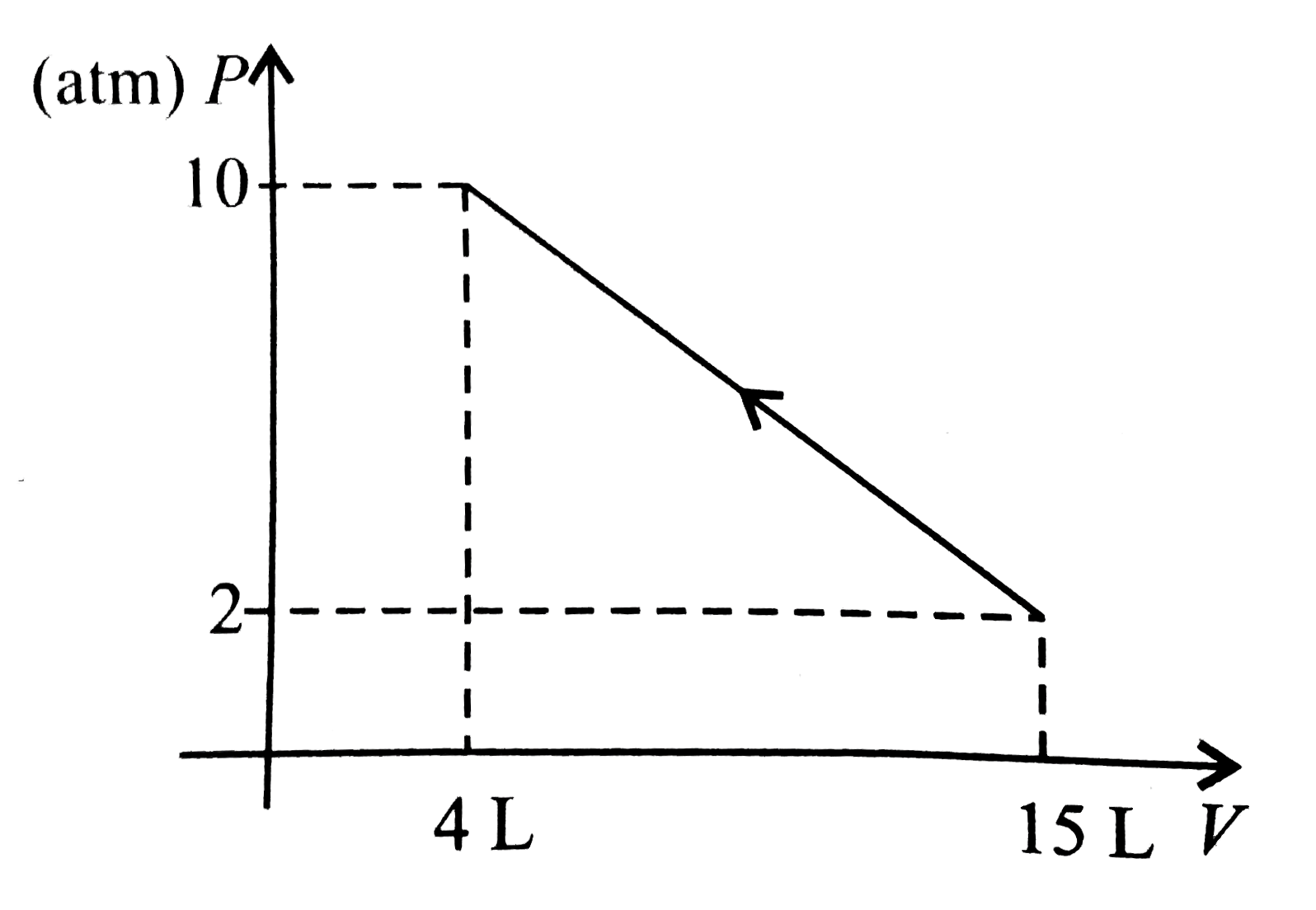
`1 mol` of a gas is changed from its initial state `(15 L, 2 atm)` to final state `(4 L, 10 atm)`. If this change can be represented by a straight line in `P-V` curve, calculate the maximum temperature that, the gas attained.

Promotional Banner

Similar Questions

Explore conceptually related problems

One mole of a gas changed from its initial state (15L,2 atm) to final state (4L,10 atm) reversibly. If this change can be represented by a straight line in P - V curve maximum temperature (approximate), the gas attained is x xx10^(2) K. Then find the value of x.

When a sample of ideal gas is changed from an initial state to a final state, various curves can be plotted for the process like P-V curve, V-T curve,P-T curve etc. For example, P-V curve for a fixed amount of an ideal gas at constant temperature is a rectangular hyperbola, V-T curve for a fixed amount of an ideal gas at constant volume is again a straight line. However, the shapes may vary if the constant parameters are also changed. Now, answer the following questions : Two moles of an ideal gas is changed from its initial state (16 atm, 6L) to final state (4 atm, 15L) in such a way that this change can be represented by a straight line in P-V curve.The maximum temperature attained by the gas during the above change is :(Take : R=1/12L atm K^(-1) "mol"^(-1) )

When a sample of ideal gas is changed from an initial state to a final state, various curves can be plotted for the process like P-V curve, V-T curve,P-T curve etc. For example, P-V curve for a fixed amount of an ideal gas at constant temperature is a rectangular hyperbola, V-T curve for a fixed amount of an ideal gas at constant volume is again a straight line. However, the shapes may vary if the constant parameters are also changed. Now, answer the following questions : Which of the following graphs is not possible for a fixed amount of ideal gas upon moving from initial state A to final state B :

When a sample of ideal gas is changed from an initial state to a final state, various curves can be plotted for the process like P-V curve, V-T curve,P-T curve etc. For example, P-V curve for a fixed amount of an ideal gas at constant temperature is a rectangular hyperbola, V-T curve for a fixed amount of an ideal gas at constant volume is again a straight line. However, the shapes may vary if the constant parameters are also changed. Now, answer the following questions : From the given plot between Z and P for a real gas the correct is :

When a sample of ideal gas is changed from an initial state to a final state, various curves can be plotted for the process like P-V curve, V-T curve,P-T curve etc. For example, P-V curve for a fixed amount of an ideal gas at constant temperature is a rectangular hyperbola, V-T curve for a fixed amount of an ideal gas at constant volume is again a straight line. However, the shapes may vary if the constant parameters are also changed. Now, answer the following questions : Two Vander waals gases have same value 'b' but different 'a' value then which of the following statement is correct under simialr condition .

One mole of an ideal gas undergoes change of state from (4 L, 3 atm) to (6 L, 5 atm). If the change in internal energy is 45 L-atm then the change of enthalpy for the process is

One mole of an ideal gas is expanded from a volume of 3L to 5L under a constant pressure of 1 atm. Calculate the work done by the gas.

A system containing real gas changes it's state from state -1 to state - 2 . State -1 ( 2atm, 3L,300K) State-2 (5 atm, 4L,500K) If change in internal energy = 30 L atm then calculate change in enthalpy.

One mole of a non-ideal gas undergoes a change of state ( 2.0 atm, 3.0L, 95 K) rarr (4.0 atm, 5.0L, 245 K) with a change in internal energy , Delta U= 30.0 L. atm . Calculate change in enthalpy of the process in L. atm .

P - V diagram of an ideal gas is shown. The gas undergoes from initial state A to final state B such that initial and final volumes are same. Select the correct alternative for given process AB.