Home
Class 12
PHYSICS
five charge q(1),q(2),q(3),q(4)and q(5) ...

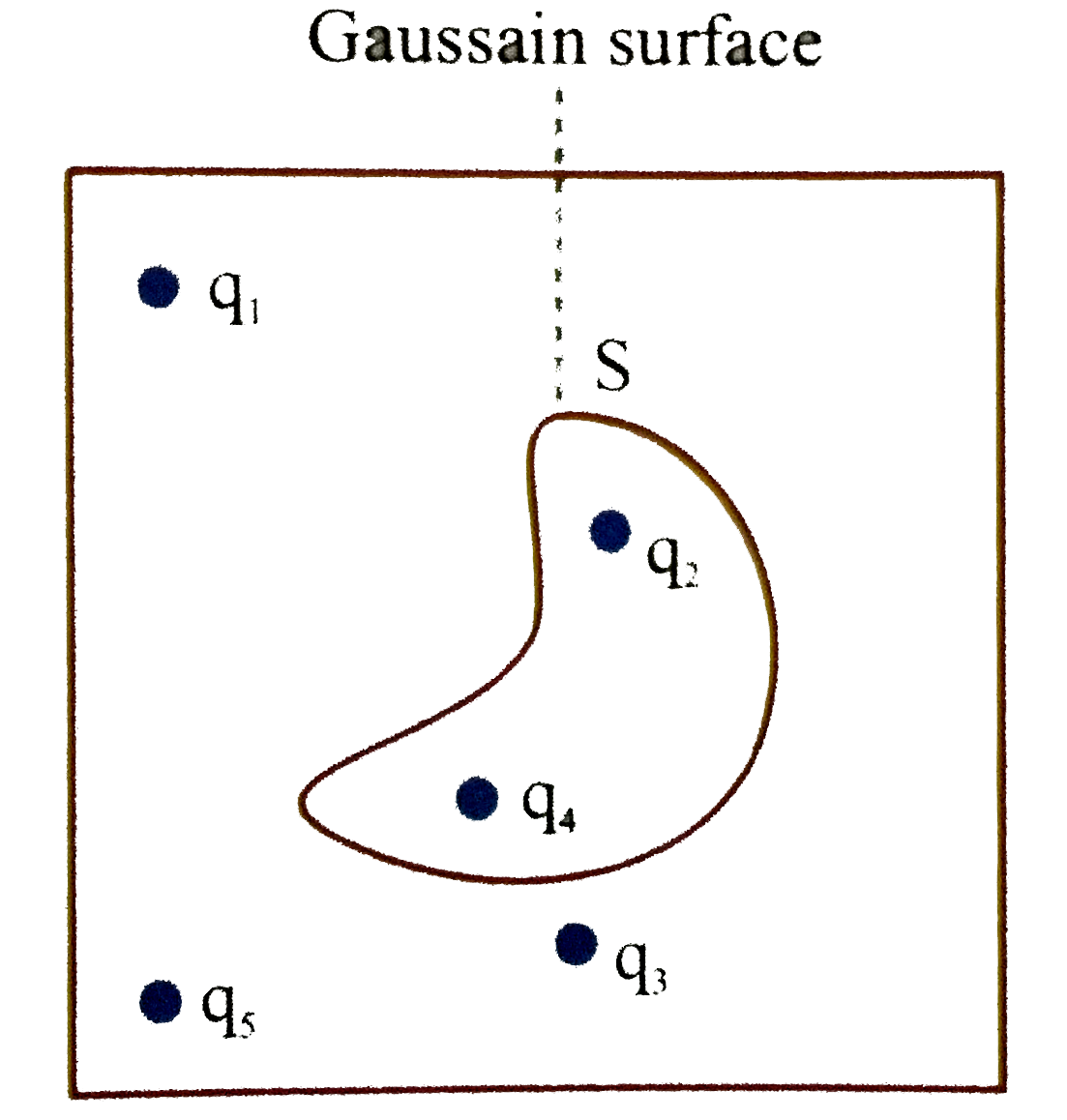
five charge `q_(1),q_(2),q_(3),q_(4)`and `q_(5)` are fixed at their positions as shown in figure .`s` is Gaussian surface .The Gauss's law is given by `ointvec(E).vec(ds)=(q)/(epsilon_(0))`

Which of the following statement is correct?

A

`vec(E)` on the LHS of the above equation will have a contribution from `q_(1), q_(2)` and `q_(3)` while q on the RHS will have a contribution from `q_(2)` and `q_(4)` only.

B

`vec(E)` on the LHS of the above equation will have a contribution from all charges while q on the RHS will have a contribution from `q_(2)` and `q_(4)` only.

C

`vec(E)` on the LHS of the above equation will have a contribution from all charges while q on the RHS will have a contribution from `q_(1), q_(3)` and `q_(5)` and only.

D

Both `vec(E)` on the LHS and q on the RHS will have contributions from `q_(2)` and `q_(4)` only.

Text Solution

Verified by Experts

The correct Answer is:

B

Electric field `(vecE)` is due to all the charges present inside as well as outside the closed surface. But electric flux `(phi=q//epsi_(0))` is contributed only by the charges inside the Gaussian surface.
Promotional Banner

Similar Questions

Explore conceptually related problems

q_(1),q_(2),q_(3) and q_(4) are point charges located at point as shown in the figure and s is a spherical Gaussian surface of radius R . Which of the following is true according to the Gauss's law

Consider Gauss's law oint vecE * vecd s = q/epsilon_0 Then, for the situation shown in figure at the Gaussian surface

Two fixed charges -2Q and +Q are located at points (-3a,0) and (+3a,0) respectively. Then which of the following statement is correct?

The value of charge q_1 ,q_2 and q_3 as shown in the figure are

In Gauss's law epsilon_(0)ointvec(E).bar(ds)= Q_("enclosed"), is vec(E) only due to charges enclosed ?

Assertion: Four point charges q_(1),q_(2),q_(3) and q_(4) are as shown in Fig,The flux over the shown Gaussians surface depends only on charges q_(1) and q_(2) Reason:Electric field at all points on Gaussians surface depends on any charges q_(1) and q_(2)

Assertion:- In a given situation of arrangement of charges, an extra charge is placed outside the Gaussion surface. In the Gauss Theroem ointvecEdvecs=(Q_(in))/(epsilon_(0))Q_(in) remains unchanged whereas electric field vecE at the site of the element is changed. Reason:- Electric field vecE at any point on the Gaussian surface is due to inside charge only.

Three charges -q_(1), +q_(2) and -q_(3) are placed as shown in the figure. The x -component of the force on -q_(1) is proportional to

Four point charges Q.q Q and q are placed at the corners of a square side 'a' as shown in the figures. Find the resultant electric force on a charge Q,
