Home
Class 12
CHEMISTRY
Calculate the frequency of the microwave...

Calculate the frequency of the microwaves with wavelength 4 (10*7)

Text Solution

Verified by Experts
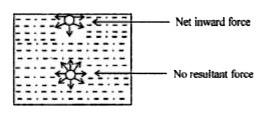
Adsorption is a surface phenomenon which arises due to unbalanced forces present on the surface of the adsorbent. Molecules present in the bulk of solid are uniformly attracted from all sides of molecules. But the molecules present at the surface of solid are attracted only by molecules present below them. There is inward pull on the molecules present at the surface. As a result, surface of adsorbent tries to satisfy their forces by attracting the molecules of other species. This mechanism of adsorption can be shown in the figure :
Promotional Banner

Topper's Solved these Questions

  • SURFACE CHEMISTRY

    OMEGA PUBLICATION|Exercise MULTIPLE CHOICE QUESTIONS|78 Videos
  • SOLUTIONS

    OMEGA PUBLICATION|Exercise Multiple Choice Questions|56 Videos
  • THE D- AND F-BLOCK ELEMENTS

    OMEGA PUBLICATION|Exercise MULTIPLE CHOICE QUESTIONS|41 Videos

Similar Questions

Explore conceptually related problems

Calculate the wave number of the microwaves with wavelength 4 (10*7)

Calculate frequency of yellow radiation having wavelength 5800 A*

Calculate the frequency of a light wave whose time period is 3 (10*-10 sec )

Calculate the frequency of photon with energy 3.98 (10*-15)

Calculate the frequency and wavelength of photon with energy 5 ( 10*-8)J.

An ion carrying a charge 3.2 xx 10^(-19)C is revolving in circular path in a magnetic field of intensity 2xx10(-4) Tesla.Calculate the frequency of revolution if the mass of ion is 7.0 xx 10^(-27) kg.

OMEGA PUBLICATION-SURFACE CHEMISTRY-MULTIPLE CHOICE QUESTIONS
  1. Calculate the frequency of the microwaves with wavelength 4 (10*7)

    Text Solution

    |

  2. How will you convert propyne into propan-2-one

    Text Solution

    |

  3. How will you convert ethyne into vinyl cyanide.

    Text Solution

    |

  4. Draw structure of 1,3-dimethyl cyclopent-1-ene

    Text Solution

    |

  5. What will happen when ethyne treated with hydrogen iun presence of pla...

    Text Solution

    |

  6. What will happen when propyne treated with hydrogen in presence of nic...

    Text Solution

    |

  7. What is lindlar"s catalyst?

    Text Solution

    |

  8. What is birch reduction?

    Text Solution

    |

  9. Sodium salt of which acid will be needed for the preparation of propan...

    Text Solution

    |

  10. Name a product obtained by heating butanoic acid with soda lime at 630...

    Text Solution

    |

  11. Which salt on treatment with soda lime gives ethane?

    Text Solution

    |

  12. Draw the structure of following : 2-methyl-3-isopropyl heptane.

    Text Solution

    |

  13. Draw the structure of following : dicyclopropyl methane

    Text Solution

    |

  14. Draw the structure of following : n C4H10

    Text Solution

    |

  15. Write iupac name of following : CH2=CH2

    Text Solution

    |

  16. Write iupac name of following : CH3-CH=CH2

    Text Solution

    |

  17. Write iupac name of following : CH3-CH2-CH=CH2

    Text Solution

    |

  18. Write iupac name of following : CH3-CH=CH-CH3

    Text Solution

    |

  19. Write iupac name of following : CH3(CH2)2CH=CH2

    Text Solution

    |

  20. Write iupac name of following : CH3(CH2)3CH=CH2

    Text Solution

    |

  21. Write iupac name of following : CH2=C(CH3)2

    Text Solution

    |

