Home
Class 12
CHEMISTRY
Account for the different magnetic behav...

Account for the different magnetic behaviour of `[Co(CN_6)]^(3-) and [CoF_6]^(3-)`.

Text Solution

Verified by Experts
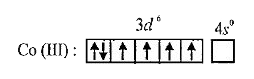
In both the cases Co is present in + 3. O.S. i.e. Co (III). So electronic configuration of Co is `d^6` i.e., there are four unpaired electrons.

Now as we know `CN^(-)` -is a strong field ligand i.e electron pairing will take place. As a result number of unpaired electrons is zero. But on the other hand in case of `[CoF_6]^(3-), F^(-)` is weak field ligand so no electron .pairing will take place and number of unpaired electrons is four. Due to presence of unpaired electrons `[CoF_6]^(3-)` is paramagnetic. But `[Co(CN)_6]^(3-)` is diamagnetic due to absence of unpaired electrons.
Promotional Banner

Topper's Solved these Questions

  • CO-ORDINATION COMPOUNDS

    OMEGA PUBLICATION|Exercise MULTIPLE CHOICE QUESTIONS |38 Videos
  • CHEMISTRY IN EVERYDAY LIFE

    OMEGA PUBLICATION|Exercise MULTIPLE CHOICE QUESTIONS (MCQs)|20 Videos
  • ELECTROCHEMISTRY

    OMEGA PUBLICATION|Exercise MULTIPLE CHOCIE QUESTION |46 Videos

Similar Questions

Explore conceptually related problems

Account for the different magnetic behaviour of [Ni(CN)_4]^(2-) and [NiCl_4]^(2-) .

Explain magnetic Behaviour of [Fe(CN)_6]^(4-) and [Fe(CN)_6]^(3-) anions.

Using valence bond theory, write the type of hybridisation involved, geometry and magnetic behaviour of [CoF_6]^(3-) and Co(NH_3)_6]^(3+) complexes.

Account for the different magnetic behaviour of hexacyanoferrate (III) and hexafluoroferrate(III).

Using valence bond theory predict the geometry and magnetic behaviour of [Pt(CN)_4]^(2-) .

Based on VBT, explain geometry and magnetic behavior of [Fe(CN)_6]^(-4) ion.

Write the shape and magnetic behaviour of the following complex : [Co(NH_3)_6 ]^(3+)

With the help of the crystal field theory predict the number of unpaired electrons in [Fe(CN)_6]^(3-) and [FeF_6]^(3-) .

predict the number of unpaired electrons in [CoF_6]^(3-) and [Co(NH_3)_6]^(3+)

On the basis of valence bond theory explain the shape and magnetic character of K_4[Fe(CN)_6] or [FeCN_6]^(4-) ion.

OMEGA PUBLICATION-CO-ORDINATION COMPOUNDS -MULTIPLE CHOICE QUESTIONS
  1. Account for the different magnetic behaviour of [Co(CN6)]^(3-) and [Co...

    Text Solution

    |

  2. An example of double salt is

    Text Solution

    |

  3. Write IUPAC name of [Co(NH3)6]Cl3.

    Text Solution

    |

  4. Name of complex [pt(NH3)6]Cl4 is

    Text Solution

    |

  5. [Co(NH3)5 Br]SO4 and [Co(NH3)5 SO4] Br areexamples of which type of i...

    Text Solution

    |

  6. Which complex has square planar structure?

    Text Solution

    |

  7. The number of d-electrons in [Cr(H2O)6]^(3+) (at. No. of Cr = 24 ) is

    Text Solution

    |

  8. The oxidation number of iron in K4[Fe (CN)6] is :

    Text Solution

    |

  9. The IUPAC name of [Co(Cl) (NO2) (en)2 ] Cl is

    Text Solution

    |

  10. Which of the following complex species involves d^2sp^3 hybridisation ...

    Text Solution

    |

  11. Which of the following acts as a positive ligand?

    Text Solution

    |

  12. The co-ordination number of Cr in [Cr(NH3)3(H2O)3]Cl3 is

    Text Solution

    |

  13. The magnetic moment of [Ni(CO4)] is

    Text Solution

    |

  14. The effective atomic number of Cr (Atomic no. = 24) in [Cr (NH3)6]Cl3 ...

    Text Solution

    |

  15. The effective atomic number of Fe in Fe(CO)5 is

    Text Solution

    |

  16. The coordination number of copper in cuprammonium sulphate is

    Text Solution

    |

  17. en is an example of a

    Text Solution

    |

  18. Ferrocene is

    Text Solution

    |

  19. Which of the following ligands is expected to be bidentate?

    Text Solution

    |

  20. The number of unpaired electrons in the complexes [NiCl4]^(-2) and [Ni...

    Text Solution

    |

  21. According to effective atomic number, the central metal acquires

    Text Solution

    |

