Home
Class 12
CHEMISTRY
With the help of valence bond theory exp...

With the help of valence bond theory expiaiil that tetracyanonickelate (II) ion is square planar or tetrahedral in nature.

Text Solution

Verified by Experts
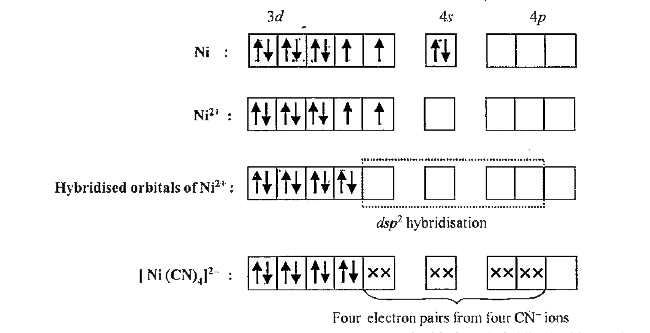
Nickel has electronic configuration in its ground state is `[Ar]3d^8 4s^2 4p^0`. It loses electrons to from `Ni^(2+)` ion. Now the hybridisation and formation of complex `[Ni(CN)_4]^(2-)` is given as below :

The two unpaired d- electrons are paired up. The one vacant 3d-orbital get hybridised with one 4s- orbital and two 4p-orbitals, resulting in to `dsp^2` hybridisation. Now these four vacant hybrid orbitals are occupied by four pairs of electrons from four `CN^(-)` ions. Thus fonned complex `[Ni(CN)_4]^(2-)` is square planar. This complex has no unpaired electrons. Hence, it is diamagnetic in nature.
Promotional Banner

Topper's Solved these Questions

  • CO-ORDINATION COMPOUNDS

    OMEGA PUBLICATION|Exercise MULTIPLE CHOICE QUESTIONS |38 Videos
  • CHEMISTRY IN EVERYDAY LIFE

    OMEGA PUBLICATION|Exercise MULTIPLE CHOICE QUESTIONS (MCQs)|20 Videos
  • ELECTROCHEMISTRY

    OMEGA PUBLICATION|Exercise MULTIPLE CHOCIE QUESTION |46 Videos

Similar Questions

Explore conceptually related problems

With the help of valence bond theory, explain the bonding and shape of complex ion [Zn(NH_3)_4]^(2+)

Choose the correct alternative : The complex [Ni(CO)_4] is square planar / tetrahedral.

Discuss the main postulates of valence bond theory.

Explain on the basis of valence bond theory that [Ni(CN)_4]^(2-) ion with square planar structure is diamagnetic and the [NiCl_4]^(2-) ion with tetrahedral geometry is paramagnetic.

Using valence bond theory explain the geometry and magnetic behaviour of pentacarbonyl iron (0).

On the basis of valence bond theory explain the structure and magnetic nature of [Fe(H_2O)_6]^(3+) complex ion.

Onthe basis of valence bond theory explain the structure and magnetic nature of [Fe(CN)_6]^(3_) complex ion.

OMEGA PUBLICATION-CO-ORDINATION COMPOUNDS -MULTIPLE CHOICE QUESTIONS
  1. With the help of valence bond theory expiaiil that tetracyanonickelate...

    Text Solution

    |

  2. An example of double salt is

    Text Solution

    |

  3. Write IUPAC name of [Co(NH3)6]Cl3.

    Text Solution

    |

  4. Name of complex [pt(NH3)6]Cl4 is

    Text Solution

    |

  5. [Co(NH3)5 Br]SO4 and [Co(NH3)5 SO4] Br areexamples of which type of i...

    Text Solution

    |

  6. Which complex has square planar structure?

    Text Solution

    |

  7. The number of d-electrons in [Cr(H2O)6]^(3+) (at. No. of Cr = 24 ) is

    Text Solution

    |

  8. The oxidation number of iron in K4[Fe (CN)6] is :

    Text Solution

    |

  9. The IUPAC name of [Co(Cl) (NO2) (en)2 ] Cl is

    Text Solution

    |

  10. Which of the following complex species involves d^2sp^3 hybridisation ...

    Text Solution

    |

  11. Which of the following acts as a positive ligand?

    Text Solution

    |

  12. The co-ordination number of Cr in [Cr(NH3)3(H2O)3]Cl3 is

    Text Solution

    |

  13. The magnetic moment of [Ni(CO4)] is

    Text Solution

    |

  14. The effective atomic number of Cr (Atomic no. = 24) in [Cr (NH3)6]Cl3 ...

    Text Solution

    |

  15. The effective atomic number of Fe in Fe(CO)5 is

    Text Solution

    |

  16. The coordination number of copper in cuprammonium sulphate is

    Text Solution

    |

  17. en is an example of a

    Text Solution

    |

  18. Ferrocene is

    Text Solution

    |

  19. Which of the following ligands is expected to be bidentate?

    Text Solution

    |

  20. The number of unpaired electrons in the complexes [NiCl4]^(-2) and [Ni...

    Text Solution

    |

  21. According to effective atomic number, the central metal acquires

    Text Solution

    |

