Home
Class 12
CHEMISTRY
11.6g of an organic compound having form...

`11.6g` of an organic compound having formula `C_n H_(2n+2)` is burnt in excess of `O_2(g)` initially taken in a `22.41` litre steel vessel. Before reactio0n the gaseous mixture was at `273K` with pressure reading 2 atm. Aftercomplete combustion and loss of considerable amount of heat, the mixture of product and excess of `O_2` had a temperature of `546K and 4.6` atm pressure. The formula of organic compound is :

Text Solution

Verified by Experts
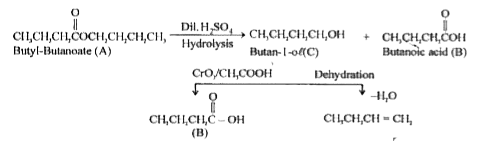
The organic compound (A) with molecular formula `C_(8)H_(16)O_(2)` upon hydrolysis with dil `H _(2)SO_(4)` gives carboxylic acid (B) and an alcohol (C). Therefore, (A) must be an ester.
Promotional Banner

Topper's Solved these Questions

  • ALCOHOLS, PHENOLS AND ETHERS

    OMEGA PUBLICATION|Exercise MULTIPLE CHOICE QUESTION|14 Videos
  • ALDEHYDES, KETONES AND CARBOXYLIC ACIDS

    OMEGA PUBLICATION|Exercise MULTIPLE CHOICE QUESTIONS |35 Videos

Similar Questions

Explore conceptually related problems

A gaseous compound is composed of 85.7% by mass carbon and 14.3% by mass hydrogen. Its density is 2.28 g/litre at 300 K and 1.0 atm pressure. Determine the molecular formula of the compound.

Calculate density of a gaseous mixture which consist of 3.01 xx 10^24 molecules of N_2 and 32 g of O_2 gas at 3 atm pressure and 860 K temperature (Given : R=1/2 atm L/mole.K )

Dinitrogen pentoxide decomposes at 475K as: N_2O_5(g) rarr N_2O_4(g) + 1/2 O_2(g) If the initial pressure is 125 mm and after 30 minutes of the reaction, total pressure of the gaseous mixture is 148 mm, calculate the average rate of reaction in atm mi n^(-1)

In the electolysis of a CuSO_4 solution, how many grams of Cu are plated out on the cathode in the time that it takes to liberate 5.6 litre of O_2 (g) , measured at 1 atm and 273 K, at the node?

Urea (H_(2)NCONH_(2)) is manufactured by passing CO_(2) (g) through ammonia solution followed by crystallization. For the above reaction is prepared by combustion of hydrocarbons. If combustion of 236 kg of a saturated hydrocarbon (C_(n)H_(2n+2)) produces as much CO_(2) as required for production of 999.6 kg urea then molecular formula of hydrocarbon is:

What amount of heat must be supplied to 2.0 xx 10^-2 kg of nitrogen (at room temperature) to raise its temperature by 45 ^@C at constant pressure ? (Molecular mass of N_2 = 28, R = 8.3 J mol^-1 K^-1. )

An organic compound A with molecular formula C_8H_8O gives positive DNP and iodoform tests. It does not reduce Tollen’s or Fehling’s reagent and does not decolourise bromine water also. On oxidation with chromic acid (H_2CrO_4) , it gives a carboxy acid (B) with molecular formula C_7H_6O_2 . Deduce the structure of A and B.

For the reaction 2A(g)+B(g)hArr C(g)+D(g), K_c=10^(12) .if initially 4,2,6,2 moles of A,B,C,D respectively are taken in a 1 litre vessel, then the equilibrium concentration of A is :

A heating coil is immersed in a 100 g sample of H_(2)O (l) at a 1 atm and 100^(@) C in a closed vessel. In this heating process , 60% of the liquid is converted to the gaseous form at constant pressure of 1 atm . The densities of liquid and gas under these conditions are 1000 kg//m^(3) and 0.60 kg//m^(3) respectively . Magnitude of the work done forthe process is : (Take : 1L-atm= 100J)

A solution containing 1.8 g of a compound (empirical formula CH_(2)O ) in 40 g of water is observed to freeze at -0.465^(@) C. The molecules formulea of the compound is ( K_(f) of water =1.86kg K mol^(-1) ):

