Home
Class 11
CHEMISTRY
Determine the empirical formula of an ox...

Determine the empirical formula of an oxide in which mass percent of iron and oxygen are 69.9 and 30.1 respectively.

Text Solution

Verified by Experts
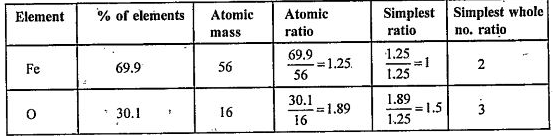
We are given that
Mass percent of iron = 69.9
Mass percent of oxygen = 30.1
We are to find out the molecular formula of an oxide

Empirical formula `= Fe_(2)O_(3)`
Molecular formula = `Fe_(2)O_(3)`
Promotional Banner

Topper's Solved these Questions

  • SOME BASIC CONCEPTS OF CHEMISTRY

    OMEGA PUBLICATION|Exercise Multiple Choice Questions (MCQs)|29 Videos
  • SAMPLE QUESTION PAPER -v (PUNJAB)

    OMEGA PUBLICATION|Exercise QUESTION|45 Videos
  • STATES OF MATTER

    OMEGA PUBLICATION|Exercise Multiple Choice Questions (MCQs) |29 Videos

Similar Questions

Explore conceptually related problems

On strongs heating, One gram of the silver salt of an organic dibasic acid yields 0.5934 g of silver. If the mass percentage of carbon in it 8 times the mass percentage of hydrogen and one - half the mass percentage of oxygen, determine the molecular formula of the acid.

Find the empirical formula of a compound containing 9.76% magnesium , 13.01%sulphur and 26.01% oxygen

Two parallel vertical metallic rails AB and CD are separated by 1m. They are connected at the two ends by resistances R_1 and R_2 as shown in the figure. A horizontal metallic bar 1 of mass 0.2 kg slides without friction, vertically down the rails under the action of gravity. There is a uniform horizontal magnetic field of 0.6 T perpendicular to the plane of the rails. It is observed that when the terminal velocity is attained, the powers dissipated in R_1 and R_2 are 0.76W and 1.2W respectively (g=9.8m//s^2) The value of R_2 is

2x-y+4=0 is a diameter of a circle which circumscribes a rectangle ABCD. If the coordinates of A, B are (4, 6) and (1, 9) respectively, find the area of this rectangle ABCD.

The empirical formula of the compound is CH3. Calculate the molecular formula if molecular mass is 30.

A rod of length 1.05 m having negligible mass is supported at its ends by two wires of steel (wire A) and aluminium (wire B) of equal lengths as shown in Fig. 9.15. The cross-sectional areas of wires A and B are 1.0 mm^2 and 2.0 mm^2 , respectively. At what point along the rod should a mass m be suspended in order to produce (a) equal stresses :

A rod of length 1.05 m having negligible mass is supported at its ends by two wires of steel (wire A) and aluminium (wire B) of equal lengths as shown in Fig. 9.15. The cross-sectional areas of wires A and B are 1.0 mm^2 and 2.0 mm^2 , respectively. At what point along the rod should a mass m be suspended in order to produce equal strains in both steel and aluminium wires.:

A rod of length l and negligible mass is suspended at its two ends by two wires of steel (wire A ) and aluminium (wire B) of equal length (shown in the figure) The cross-sectional areas of wires A and B are 1.0 mm^2 and 2.0 mm^2 , respectively. (Y_(AL) = 70 xx 10^9 N m^-2 and y _(steel) = 200 xx 10^9 N m^-2)

What is the simplest formula of the compound which has the following percentage composition carbon 80% , hydrogen 20% , if the molecular mass is 30. calculate its molecular formula ?

Critical temperature for carbon dioxide and methane are 31.1^(@)C and -81.9^(@)C respectively. Which of these has stronger intermolecular forces and why ?

