Home
Class 11
CHEMISTRY
Define solubility product of a salt....

Define solubility product of a salt.

Text Solution

Verified by Experts
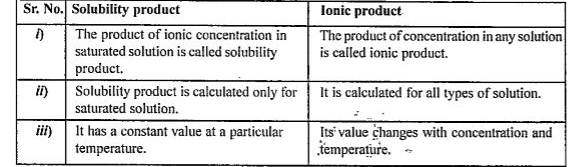
Solubility product of a salt at a given temperature is defined as, the product of molar concentration of ions in its saturated solution, raised to power equal to the number of ions formed in equation for solubility equilibrium."
Differences between solubility product and ionic product are as follows :
Promotional Banner

Topper's Solved these Questions

  • EQUILIBRIUM

    OMEGA PUBLICATION|Exercise Multiple Choice Questions (MCQs)|25 Videos
  • ENVIRONMENTAL CHEMISTRY

    OMEGA PUBLICATION|Exercise Multiple Choice Question (MCQs)|23 Videos
  • HYDROCARBONS

    OMEGA PUBLICATION|Exercise MULTIPLE CHOICE QUESTIONS (MCQs)|24 Videos

Similar Questions

Explore conceptually related problems

Discuss the applications of calculation of solubility product of a sparingly soluble salt.

Define solubility product. How does it differ from ionic product ?

A_(3)B_(2) is a sparingly soluble salt with molar mass M(gmol_(-)) and solubility x gm litre_(-1) , the ratio of the molar concentration of B^(3-) to the solubilty product of the salt is :-

The solubility of silver chloride (AgCl) in water at 25^(@)C ia 1.06 xx 10^(-5) mol L^(-1) . Calculate the solubility product of AgCl at this temperature.

Determine the solubilities of silver chromate at 298 K from their solubility product constants 1.1 xx 10^(-12) .

If the solubility product of CuS is 6 xx 10^(-16) , calculate the maximum molarity of CuS in aqueous solution.

The solubility of electrolytes MX_(1),MX_(2) and MX_(3) is 1xx10^(-3) moles per litre. Hence their respective solubility products are :

The solubility product of AgCl is 10^(-10)M^(2) . The minimum volume ( in m^(3)) of water required to dissolve 14.35 mg of AgCl is approximately :

OMEGA PUBLICATION-EQUILIBRIUM -Multiple Choice Questions (MCQs)
  1. Define solubility product of a salt.

    Text Solution

    |

  2. List the value of n and l for the following orbitals : 4s

    Text Solution

    |

  3. For the reaction , 2HI hArr H(2) + I(2)

    Text Solution

    |

  4. Equilibrium constant for the reaction 2NO(g) + Cl(2)(g) hArr 2NOCl(g) ...

    Text Solution

    |

  5. k(1) and k(2) are the velocity constants of forward and backward react...

    Text Solution

    |

  6. The number of electrons present in 3d of Cu+ is ........

    Text Solution

    |

  7. Consider the reaction 2CO(g)+O(2)(g)hArr2CO(2)(g)+Heat Under what co...

    Text Solution

    |

  8. Using s, p, d notations, describe the orbital with the quantum number....

    Text Solution

    |

  9. Using s, p, d notations, describe the orbital with the quantum number....

    Text Solution

    |

  10. Which of the following is strongest acid ?

    Text Solution

    |

  11. What is the structural formula of 2-Chloro-2-methylpropane?

    Text Solution

    |

  12. What is the structural formula of 2-Chlorobutane?

    Text Solution

    |

  13. What is the structural formula of 1-Chloro-3-methylpentane?

    Text Solution

    |

  14. What is the structural formula for 1-Chloro-2,2-dimethylpropane?

    Text Solution

    |

  15. What is the structural formula for Ethylene dibromide?

    Text Solution

    |

  16. What is the structural formula of 1-Bromo-2,3-dichlorobutane?

    Text Solution

    |

  17. The pH indicators are

    Text Solution

    |

  18. What is incorrect about buffer solution ?

    Text Solution

    |

  19. Precipitation takes place when the ionic product

    Text Solution

    |

  20. Which of the following is an example of heterogeneous equilibrium ?

    Text Solution

    |

  21. For the reaction, a A + b B rarr Products. According to law of mass ac...

    Text Solution

    |

