Home
Class 11
CHEMISTRY
Fluorine reacts with ice and results in ...

Fluorine reacts with ice and results in the change :
`H_(2)O(s) + F_(2)(g) rarr HF(g) + HOF(g)`
Justify that this reaction is a redox reaction.

Text Solution

Verified by Experts
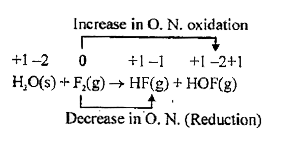

Here `F_(2)` is oxisied to HOF and reduced to HF, therefore it is a redox reaction.
Promotional Banner

Topper's Solved these Questions

  • REDOX REACTIONS

    OMEGA PUBLICATION|Exercise MULTIPLE CHOICE QUESTIONS (MCQs) |25 Videos
  • ORGANIC CHEMISTRY SOME BASIC PRINCIPLES AND TECHNIQUES

    OMEGA PUBLICATION|Exercise MULTIPLE CHOICE QUESTIONS|26 Videos
  • SAMPLE QUESTION PAPER -I (PUNJAB)

    OMEGA PUBLICATION|Exercise QUESTION|41 Videos

Similar Questions

Explore conceptually related problems

Justify tht the reaction 2Na(s) + H_(2)(g) rarr 2NaH(s) is a redox reaction.

The following reaction is an example of a 4NH_3(g) + 5O_2(g) rarr 4NO(g) + 6H_2O(g) (i) displacement reaction (ii) Combination reaction (iii) redox reaction (iv) neutralisation reaction

The following rate data were obtained for the reaction : 2NO(g) + O_2(g) rarr 2 NO_2 (g) Determine the rate law expression and order of the reaction.

identify the type of reaction in the followng example 2H_2(g) + O_2(g) rarr 2H_2O(l)

In the reaction, SO_2(g) + 2H_2S (g) rarr 2H_2O (l) + S (s) the reducing agents is

Balance the following equation : CH_4(g) +O_2(g) rarr CO_2 (g)+H_2O(l)

For the reactions : C(s) + O_(2) (g) to CO_(2) (g)

Express the instantenus rate of the reaction N_2(g) + 3H_2(g) rarr 2NH_3(g)' In terms of various reactants and products.

Consider the chemical reaction, N _(2) (g) + 3 H _(2)(g) to 2 NH _(3) (g). The rate of this reaction can be expressed in terms of time derivative of concentration of N _(2) (g), H _(2) (g) or NH _(3) (g). Identify the correct relationship amongest the rate expression.

OMEGA PUBLICATION-REDOX REACTIONS -MULTIPLE CHOICE QUESTIONS (MCQs)
  1. Fluorine reacts with ice and results in the change : H(2)O(s) + F(2)...

    Text Solution

    |

  2. Electrolysis involves oxidation and reduction respectively at

    Text Solution

    |

  3. The cathode in a galvanic cell and electrolytic cell is

    Text Solution

    |

  4. In a galvanic cell,

    Text Solution

    |

  5. K, Ca and Li metals may be arranged in the decreasing order of their s...

    Text Solution

    |

  6. The standard reduction potential of three metallic cations X, Y and Z ...

    Text Solution

    |

  7. Arrange the following in the decreasing order of their acidic strength...

    Text Solution

    |

  8. Calculate the oxidation number of P in phosphate ion.

    Text Solution

    |

  9. Calculate the oxidation number of P in H3PO3

    Text Solution

    |

  10. Calculate the oxidation number of C in C2H6

    Text Solution

    |

  11. How many orbitals are present in f subshell.

    Text Solution

    |

  12. Galvanised iron sheets are coated with: C, Cu, Zn, Ni.

    Text Solution

    |

  13. According to classical concept, oxidation is a process of

    Text Solution

    |

  14. According to electronic concept, oxidation involves

    Text Solution

    |

  15. Write down the values of azimuthal quantum number possible for electro...

    Text Solution

    |

  16. How many orbitals are present in p subshell .

    Text Solution

    |

  17. How many orbitals are present in s subshell.

    Text Solution

    |

  18. In case of oxidation, there is

    Text Solution

    |

  19. Calculate mass of 2.7moles of C(12)H(22)O(11) (molar mass = 342 g/ mol...

    Text Solution

    |

  20. The most common oxidation state of an element is -2. The number of ele...

    Text Solution

    |

  21. In the conversion of K(2)Cr(2)O(7) "to K"(2)CrO(4), the oxidation numb...

    Text Solution

    |

