Home
Class 12
CHEMISTRY
Aoverset("Dil. "H(2)SO(4)//Hg^(2+))to 1 ...

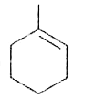
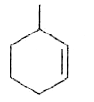
`Aoverset("Dil. "H_(2)SO_(4)//Hg^(2+))to` 1 - Methylcyclohexanol. Here A is :

A

B

C

D

a or b

Text Solution

AI Generated Solution

The correct Answer is:

To solve the problem, we need to identify the compound A that, when treated with dilute H₂SO₄ and mercuric ions (Hg²⁺), produces 1-methylcyclohexanol. Let's break down the steps involved in the solution. ### Step-by-Step Solution: 1. **Understanding the Product**: - The product of the reaction is 1-methylcyclohexanol. This indicates that the compound A must be an alkene that, upon hydration, leads to this alcohol. - The structure of 1-methylcyclohexanol consists of a cyclohexane ring with a hydroxyl (OH) group and a methyl (CH₃) group attached to it. 2. **Identifying the Reaction Type**: - The reaction involves hydration of an alkene. The presence of dilute H₂SO₄ and Hg²⁺ suggests that we are dealing with an electrophilic addition reaction where water is added across a double bond. 3. **Formation of Carbocation**: - For the hydration to occur, a carbocation intermediate must form. The stability of the carbocation will influence the outcome of the reaction. More stable carbocations will form preferentially. - We need to examine the possible carbocations that can be formed from different alkenes. 4. **Analyzing Possible Structures for A**: - We need to consider various alkenes that could lead to the formation of 1-methylcyclohexanol upon hydration. - The alkenes should be such that when they react with H₂SO₄ and Hg²⁺, they can generate a carbocation that, after hydration, results in the desired product. 5. **Evaluating Options**: - After analyzing the possible structures for A, we find that both options A and B can lead to the formation of the required carbocation. - Both structures will generate a carbocation that can stabilize through hyperconjugation or resonance, allowing for the addition of water to yield 1-methylcyclohexanol. 6. **Conclusion**: - Since both A and B can produce the desired product after hydration, the correct answer is option D, which states that A or B can be the answer. ### Final Answer: The correct answer is **D (A or B)**.

To solve the problem, we need to identify the compound A that, when treated with dilute H₂SO₄ and mercuric ions (Hg²⁺), produces 1-methylcyclohexanol. Let's break down the steps involved in the solution. ### Step-by-Step Solution: 1. **Understanding the Product**: - The product of the reaction is 1-methylcyclohexanol. This indicates that the compound A must be an alkene that, upon hydration, leads to this alcohol. - The structure of 1-methylcyclohexanol consists of a cyclohexane ring with a hydroxyl (OH) group and a methyl (CH₃) group attached to it. ...
Promotional Banner

Similar Questions

Explore conceptually related problems

Identify A and B in the given reaction (A) overset("Dil. "H_(2)SO_(4)//HgSO_(4))rarr underset("(unstable)")underset("vinyl alcohol")({:(CH_(2)),("||"),("CHOH"):})rarr(B)

Consider the following reaction sequence , CH_(3)CH(OH)CH_(3) overset("Conc" H_(2)SO_(4))underset("Heat")(to) X underset(H_(2)O) overset("dil." H_(2)SO_(4))(to) Y X and Y in the reaction respectively are

In the reaction sequence: CrO_(2)Cl_(2)overset(NaOH) to A overset(dil. H_(2)SO_(4)) to B overset (NaOH) to C overset(AgNO_(3)) to D Identify [A] to [D] .

Ph - C -= C-CH_(3) overset(Hg^(2+)//H_(2)SO_(4)(aq)) to A The major product (A) formed is -

S+HNO_(3)(Dil.) to H_(2)SO_(4)+Nouarr

CH_(3)-C-=CHunderset(dil.H_(2)SO_(4))overset(HgSO_(4))(to) product Product of the above reaction is

HC-=CHoverset(Dil. H_2SO_4)underset(+Hg^(2+))rarrCH_3CH=0 Which statement(s) is/are correct about the given reaction?

Identify the compounds A, B and C : (i) C_(6)H_(5)COOH overset(PCl_(5)) to A overset(H_(2)-Pd//BaSO_(4)) to B overset("KCN alc")underset("distil") to C (ii) H-C -= C - H overset(H_(2)O)underset(" dil "H_(2)SO_(4) + HgSO_(4)) to A underset("Ni")overset(H_(2)) to B overset(140^(@) C)underset("conc" H_(2)SO_(4)) to C

overset (Cyclobutyl ethene) underset ((A)) overset (Dil. H_(2)SO_(4)) rarr (B) (Number of isomeric products including stero-isomers)

CH_(3)-C-=CHunderset(Hg^(+2))overset(dil.H_(2)SO_(4))(to)Xunderset(Delta)overset(Ba(OH)_(2))(to)Y,Y is
