Home
Class 12
CHEMISTRY
Sodium tertiary butoxide forms ether onl...

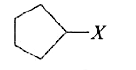
Sodium tertiary butoxide forms ether only with :

A

B

`CH_(3)-X`

C

`H_(3)C-overset(X)overset(|)(CH)-CH_(3)`

D

`H_(3)C-underset(CH_(3))underset(|)overset(X)overset(|)(C)-CH_(3)`

Text Solution

AI Generated Solution

The correct Answer is:

To solve the question "Sodium tertiary butoxide forms ether only with:", we need to analyze the reactivity of sodium tertiary butoxide (Na⁺[C(CH₃)₃O]⁻) in the context of ether formation. ### Step-by-Step Solution: 1. **Understanding Sodium Tertiary Butoxide**: Sodium tertiary butoxide is the sodium salt of tertiary butyl alcohol (C(CH₃)₃OH). It can be represented as Na⁺[C(CH₃)₃O]⁻, where the alkoxide ion (C(CH₃)₃O⁻) acts as a strong nucleophile. **Hint**: Remember that sodium tertiary butoxide is derived from a tertiary alcohol, which influences its reactivity. 2. **Reactivity of Alkoxide Ions**: Alkoxide ions are strong nucleophiles and can also act as bases. However, their ability to form ethers depends on the nature of the alkyl halide they react with. **Hint**: Consider the nucleophilic strength of alkoxide ions and how it affects their reactions with different types of alkyl halides. 3. **Types of Alkyl Halides**: - **Primary Alkyl Halides**: React well with alkoxide ions to form ethers. - **Secondary Alkyl Halides**: Steric hindrance makes them less reactive with alkoxide ions, often leading to elimination reactions instead of ether formation. - **Tertiary Alkyl Halides**: React poorly with alkoxide ions due to steric hindrance and typically undergo elimination reactions to form alkenes. **Hint**: Identify the type of alkyl halide that would favor ether formation when reacted with a strong nucleophile. 4. **Conclusion**: Sodium tertiary butoxide will effectively form ethers only with primary alkyl halides. For example, if we take a primary alkyl halide like methyl chloride (CH₃Cl), the reaction would yield tert-butyl methyl ether (C(CH₃)₃OCH₃). **Hint**: Look for a primary alkyl halide in the options provided to determine the correct answer. ### Final Answer: Sodium tertiary butoxide forms ether only with primary alkyl halides.

To solve the question "Sodium tertiary butoxide forms ether only with:", we need to analyze the reactivity of sodium tertiary butoxide (Na⁺[C(CH₃)₃O]⁻) in the context of ether formation. ### Step-by-Step Solution: 1. **Understanding Sodium Tertiary Butoxide**: Sodium tertiary butoxide is the sodium salt of tertiary butyl alcohol (C(CH₃)₃OH). It can be represented as Na⁺[C(CH₃)₃O]⁻, where the alkoxide ion (C(CH₃)₃O⁻) acts as a strong nucleophile. **Hint**: Remember that sodium tertiary butoxide is derived from a tertiary alcohol, which influences its reactivity. ...
Promotional Banner

Similar Questions

Explore conceptually related problems

Formation of methyl tertiary butyl ether by the reaction of sodium tertiary butoxide and methyl bromide involves.

3-Pentanol on reaction with aluminium tertiary butoxide in the presence of acetone gives

What product is expected when tertiary butyl bromide is reacted with sodium ethoxide? Why that product is not formed and how that product can be obtained?

An alkyl halide (X) of the folmula C_(6)H_(13)Cl on treatment with potassium tertiary butoxide gives two isomeric alkenes (Y) and (Z)(C_(6)H_(12)) . Both the alkenes on hydrogenation give 2,3- dimethyl butane. Perdict the structures of (X),(Y) , and (Z)

Sodium thiosulphate is formed when:

Assertion (A) : Reaction between (Me_(3)CONa) (sodium ter-butoxide) and ethyliode (C_(2)H_(5)I) does not produce an ether. Reason (R): Sodium ter-butoxide is a very strong base but is not a nucleophile.

An organic compound (a) reacts with sodium metal and forms (b) . On heating with conc. H_(2)S0_(4) (a) gives diethyl ether. (a) and (b) are respectively
