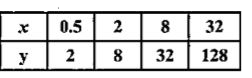
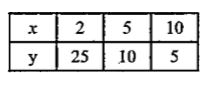
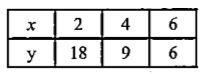
A
B
C
D
Text Solution
Verified by Experts



Topper's Solved these Questions
DIRECT AND INVERSE PROPORTIONS
NAND LAL PUBLICATION|Exercise ADDITIONAL QUESTIONS FOR PRACTICE( Fill in the blank )|12 VideosDIRECT AND INVERSE PROPORTIONS
NAND LAL PUBLICATION|Exercise ADDITIONAL QUESTIONS FOR PRACTICE( Short Answer Type Questions ) |9 VideosDIRECT AND INVERSE PROPORTIONS
NAND LAL PUBLICATION|Exercise EXERCISE 13.2|16 VideosDATA HANDLING
NAND LAL PUBLICATION|Exercise SAMPLE PAPER FOR PRACTICE |10 VideosEXPONENTS AND POWER
NAND LAL PUBLICATION|Exercise SAMPLE PAPER FOR PRACTICE |22 Videos
Similar Questions
Explore conceptually related problems
NAND LAL PUBLICATION-DIRECT AND INVERSE PROPORTIONS-ADDITIONAL QUESTIONS FOR PRACTICE ( Objective Type Questions) ( Fill in the blank spaces )
- If x(1), x(2) are two variables of x and y(1) , y(2) that of y corresp...
Text Solution
|
- Assuming land to be uniformly fertile the area of land and yield on it...
Text Solution
|
- If both x and y are in direct proportion then (1)/(x) and (1)/(y) are ...
Text Solution
|
- If x=10 , y=14 and both vary in direct proportion then which of the fo...
Text Solution
|
- In which case two quantities vary directly. a. b. c. d. none
Text Solution
|
- If 150 : x = 2.9 : 17.4 then x is a square of
Text Solution
|
- If x -4y=0 then x and y vary a. Inversely b. directly c. none
Text Solution
|