Home
Class 10
CHEMISTRY
What would be the electron-dot structure...

What would be the electron-dot structure of a molecule of sulphur which is made up of eight atoms of sulphur? (HINT. The eight atoms of sulphur are joined together in the from of ring.)

Text Solution

Verified by Experts
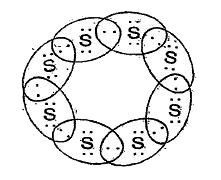
The eight atoms of sulphur are joined together form of a ring.

Eight atoms `(-S_(8))` of sulphur molecule
Promotional Banner

Topper's Solved these Questions

  • CARBON AND ITS COMPOUNDS

    NAND LAL PUBLICATION|Exercise EXERCISES|18 Videos
  • CARBON AND ITS COMPOUNDS

    NAND LAL PUBLICATION|Exercise ADDITIONAL QUESTIONS|3 Videos
  • CARBON AND ITS COMPOUNDS

    NAND LAL PUBLICATION|Exercise ACTIVITY 4.12|6 Videos
  • ACIDS, BASES AND SALTS

    NAND LAL PUBLICATION|Exercise ADDITIONAL QUESTIONS|8 Videos
  • CHEMICAL REACTIONS AND EQUATIONS

    NAND LAL PUBLICATION|Exercise ADDITIONAL QUESTIONS|5 Videos

Similar Questions

Explore conceptually related problems

What would be the electron-dot structure of potassium oxide which has the formula K2O?

How many molecules and atoms of sulphur are present in 0.1 mole of S8 molecule?

Sulphur has an atomic number 16 and a mass of 32. State the number of protons and neutrons in the nucleus of sulphur. Give a simple diagram to show the arrangement of electrons in an atom of sulphur.

In multi-molecular colloids, the colloidal particles are an aggregate of atoms or small molecules with a diameter of less than 1 nm. The molecules in the aggregate are held together by van der Waal's forces of attraction: Examples of such colloids include gold sol and sulphur sol. In macro-molecular colloids, the colloidal particles are large molecules having colloidal dimensions. These particles have a high molecular mass. When these particles are dissolved in a liquid, sol is obtained. For example: starch, nylon, cellulose, etc. Certain substances tend to behave like normal electrolytes at lower concentrations. However, at higher concentrations, these substances behave as colloidal solutions due to the foirnation of aggregated particles. Such colloids are called aggregated colloids. What are aggregated colloids ?

In multi-molecular colloids, the colloidal particles are an aggregate of atoms or small molecules with a diameter of less than 1 nm. The molecules in the aggregate are held together by van der Waal's forces of attraction: Examples of such colloids include gold sol and sulphur sol. In macro-molecular colloids, the colloidal particles are large molecules having colloidal dimensions. These particles have a high molecular mass. When these particles are dissolved in a liquid, sol is obtained. For example: starch, nylon, cellulose, etc. Certain substances tend to behave like normal electrolytes at lower concentrations. However, at higher concentrations, these substances behave as colloidal solutions due to the foirnation of aggregated particles. Such colloids are called aggregated colloids. What are macromolecular colloids ?

Read the given passage and answers following questions : In multi-molecular colloids, the colloidal particles are an aggregate of atoms or small molecules with a diameter of less than 1 nm. The molecules in the aggregate are held together by van der Waal's forces of attraction. Examples of such colloids include gold sol and sulphur sol. In macro-molecular colloids, the colloidal particles are large molecules having colloidal dimensions. These particles have a high molecular mass. When these particles are dissolved in a liquid, sol is obtained. For example: starch, nylon, cellulosc, etc. Certain substances tend to behave like normal electrolytes at lower concentrations. However, at higher concentrations, these substances behave as colloidal solutions due to the formation of aggregated particles. Such colloids are called aggregated colloids. At what concentration Certain substances tend to behave like normal electrolytes ?

Read the given passage and answers following questions : In multi-molecular colloids, the colloidal particles are an aggregate of atoms or small molecules with a diameter of less than 1 nm. The molecules in the aggregate are held together by van der Waal's forces of attraction. Examples of such colloids include gold sol and sulphur sol. In macro-molecular colloids, the colloidal particles are large molecules having colloidal dimensions. These particles have a high molecular mass. When these particles are dissolved in a liquid, sol is obtained. For example: starch, nylon, cellulosc, etc. Certain substances tend to behave like normal electrolytes at lower concentrations. However, at higher concentrations, these substances behave as colloidal solutions due to the formation of aggregated particles. Such colloids are called aggregated colloids. What are macromolecular colloids?

