Home
Class 10
PHYSICS
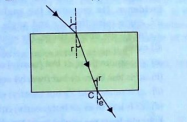
While performing the experiment on traci...

While performing the experiment on tracing the path of a ray of light pasing thourgh a glass slab as shown in the figure, four students interpreted the results as given, choose the correct option

A

`anlge rgtanglee`

B

`angle r=angle e`

C

`angle i=angle r`

D

`angle i=angle e`

Text Solution

Verified by Experts

Promotional Banner

Topper's Solved these Questions

  • REFLECTION AND REFRACTION

    MODERN PUBLICATION|Exercise EXAMPLE|138 Videos
  • MAGNETIC EFFECTS OF ELECTRIC CURRENT

    MODERN PUBLICATION|Exercise EXERCISE|265 Videos
  • SOURCES OF ENERGY

    MODERN PUBLICATION|Exercise EXAMPLE|92 Videos

Similar Questions

Explore conceptually related problems

Consider a light beam incident from air to a glass slab at Brewster's angle as shown in Fig. EP 10.1. A polarised is placed in the path of the emergent ray at point P and rotated about an axis passing through the center and perpendicular to the plane of the polaroid.

In these question, a statement of asertion followed by a statement of reason is given .Choose the correct answer out of the following choices: Assertion and reason both are correct statements and reason is correct explanation for assertion. Assertion and reason both are correct statements but reason is not correct explanation for assertion. Assertion is correct statement but reason is wrong statement. Assertion is wrong statement but reason is correct statement. Assertion:In Young's double slit experiment,the fringe width for dark fringes is equal to that for white fringes . Reason:In Young's double slit experiment performed with a source of white light ,only black and white fringes are observed.

In these question, a statement of asertion followed by a statement of reason is given .Choose the correct answer out of the following choices: Assertion and reason both are correct statements and reason is correct explanation for assertion. Assertion and reason both are correct statements but reason is not correct explanation for assertion. Assertion is correct statement but reason is wrong statement. Assertion is wrong statement and reason is also false statement. Assertion:In Young's double slit experiment ,the fringe width for dark fringes is different from that for white fringes. Reason:In Young's double slit experimnet performed witha source of white light ,only black and bright fringes are observed.

The existence of negatively charged particle in an atom was shown by J.J. Thomson as a result of the studies of the passage of electricity through gases at extremely low pressure known as discharge tube experiments. When a high voltage of the order of 10,000 volts or more was impressed across the electrodes, some sort of invisible rays moved from the negative electrode to the positive electrode these rays are called as cathode rays. Cathode rays travel in straight path in absence of electrical and magnetic field . Cathode rays consist of material part and charged particles? Cathode rays produce X-rays and light is emitted when they strike on ZnS screen. Cathode rays penetrate through thin sheets of aluminium and other metals . They affect the photogenic plate and passes heating effect when they strike on metal foil. The raito of charge to mass i.e charge/mass is same for all the cathode rays irrespective of the gas used in the tube. The existence of positively charged particle in an atom was shown be E. Goldstein. He repeated the same discharge tube experiments by using a perforated cathode. It was observed that when a high potential difference was applied between the electrodes, not only cathode rays were produced but also a new type of rays were produced simultaneoulsy from anode moving towards cathode and passes through the holes or canal of the cathode. These termed as canal rays or anode rays. These rays travel in straight lines and consists of positively charged particles. These rays have kinetic energy and produces heating effect also. The e/m ratio of these rays is smaller than that of electrons. Unlike cathode rays, their e/m value is dependent upon the nature of the gas taken in the tube. These rays produced flashes of light on ZnS screen and can pass throughs thin metal foils. They can produce physical and chemical changes and are capable to produce ionisation in gases. For cathode rays the value of e/m:

The existence of negatively charged particle in an atom was shown by J.J. Thomson as a result of the studies of the passage of electricity through gases at extremely low pressure known as discharge tube experiments. When a high voltage of the order of 10,000 volts or more was impressed across the electrodes, some sort of invisible rays moved from the negative electrode to the positive electrode these rays are called as cathode rays. Cathode rays travel in straight path in absence of electrical and magnetic field . Cathode rays consist of material part and charged particles? Cathode rays produce X-rays and light is emitted when they strike on ZnS screen. Cathode rays penetrate through thin sheets of aluminium and other metals . They affect the photogenic plate and passes heating effect when they strike on metal foil. The raito of charge to mass i.e charge/mass is same for all the cathode rays irrespective of the gas used in the tube. The existence of positively charged particle in an atom was shown be E. Goldstein. He repeated the same discharge tube experiments by using a perforated cathode. It was observed that when a high potential difference was applied between the electrodes, not only cathode rays were produced but also a new type of rays were produced simultaneoulsy from anode moving towards cathode and passes through the holes or canal of the cathode. These termed as canal rays or anode rays. These rays travel in straight lines and consists of positively charged particles. These rays have kinetic energy and produces heating effect also. The e/m ratio of these rays is smaller than that of electrons. Unlike cathode rays, their e/m value is dependent upon the nature of the gas taken in the tube. These rays produced flashes of light on ZnS screen and can pass throughs thin metal foils. They can produce physical and chemical changes and are capable to produce ionisation in gases. Which is not true with respect to cathode rays?

The existence of negatively charged particle in an atom was shown by J.J. Thomson as a result of the studies of the passage of electricity through gases at extremely low pressure known as discharge tube experiments. When a high voltage of the order of 10,000 volts or more was impressed across the electrodes, some sort of invisible rays moved from the negative electrode to the positive electrode these rays are called as cathode rays. Cathode rays travel in straight path in absence of electrical and magnetic field . Cathode rays consist of material part and charged particles? Cathode rays produce X-rays and light is emitted when they strike on ZnS screen. Cathode rays penetrate through thin sheets of aluminium and other metals . They affect the photogenic plate and passes heating effect when they strike on metal foil. The raito of charge to mass i.e charge/mass is same for all the cathode rays irrespective of the gas used in the tube. The existence of positively charged particle in an atom was shown be E. Goldstein. He repeated the same discharge tube experiments by using a perforated cathode. It was observed that when a high potential difference was applied between the electrodes, not only cathode rays were produced but also a new type of rays were produced simultaneoulsy from anode moving towards cathode and passes through the holes or canal of the cathode. These termed as canal rays or anode rays. These rays travel in straight lines and consists of positively charged particles. These rays have kinetic energy and produces heating effect also. The e/m ratio of these rays is smaller than that of electrons. Unlike cathode rays, their e/m value is dependent upon the nature of the gas taken in the tube. These rays produced flashes of light on ZnS screen and can pass throughs thin metal foils. They can produce physical and chemical changes and are capable to produce ionisation in gases. Select the incorrect statement.

Direction. In the follwing questions, a statement of assertion is followed by a statement of reason. While answering a question, you are required to choose the correct are out of the given four responses and mark it as (A). If both assertion and reason are true and reason is the correct explanation of the assertion, (B) if both assertion and reason are true but reason is not correct explanation of the assertion. (C) if asssertion is true, but reason if false, (D) if both assertion and reason are false Assertion : The energy of a charged particle does not change, when it moves inside the magnetic field. Reason: It is because, force on the charged particle due to the magnetic field acts perpendicular to its path.

Direction. In the follwing questions, a statement of assertion is followed by a statement of reason. While answering a question, you are required to choose the correct are out of the given four responses and mark it as (A). If both assertion and reason are true and reason is the correct explanation of the assertion, (B) if both assertion and reason are true but reason is not correct explanation of the assertion. (C) if asssertion is true, but reason if false, (D) if both assertion and reason are false Assertion : If an electron and proton enter a magnetic field with equal momentum, then the paths of both of them will be equally curved. Reason: The magntiude of charge on an electron is same as that on a proton.

Direction. In the follwing questions, a statement of assertion is followed by a statement of reason. While answering a question, you are required to choose the correct are out of the given four responses and mark it as (A). If both assertion and reason are true and reason is the correct explanation of the assertion, (B) if both assertion and reason are true but reason is not correct explanation of the assertion. (C) if asssertion is true, but reason if false, (D) if both assertion and reason are false Assertion : In a metre bridge experiment, the balance pont should be btained near the 50 cm mark. Reason : The instrument is based on Wheatstone bridge and it is most sensitive, when the ratio arms are nearly equal.

Direction. In the follwing questions, a statement of assertion is followed by a statement of reason. While answering a question, you are required to choose the correct are out of the given four responses and mark it as (A). If both assertion and reason are true and reason is the correct explanation of the assertion, (B) if both assertion and reason are true but reason is not correct explanation of the assertion. (C) if asssertion is true, but reason if false, (D) if both assertion and reason are false Assertion : A proton and an alpha particle having the same kinetic energy are moving in ircular paths in a uniform magnetic field. the radii of the ciruclar paths will be equal Reasons: Any two charged particles having equal kinetic energies and entering a region of uniform magnetic field vecb in a direction perpendicualr to the vecb , will describe circular trajectories of equal radii.

MODERN PUBLICATION-REFLECTION AND REFRACTION-EXAMPLE
  1. While performing the experiment on tracing the path of a ray of light ...

    Text Solution

    |

  2. A concave mirror of focal length 20 cm forms a real image at a distanc...

    Text Solution

    |

  3. A convex mirror used on an automobile has a radius of curvature of 3 m...

    Text Solution

    |

  4. An object 1 cm high is place on the axis and 15 cm from a concave mirr...

    Text Solution

    |

  5. The image formed by a concave mirror is half in size of the object. If...

    Text Solution

    |

  6. An object 5 cm high is placed at a distance of 10 cvm from a convex mi...

    Text Solution

    |

  7. When an object is placed at a distance of 60 cm from a convex spherica...

    Text Solution

    |

  8. Find the position of an object which when placed in front of a concave...

    Text Solution

    |

  9. An object is placed 10 cm from a concave mirror of radius of curvature...

    Text Solution

    |

  10. An object is placed 15 cm from a convex mirror of radius of curvature ...

    Text Solution

    |

  11. A 4.5 cm needle is placed 12 cm away from a convex mirror of focal len...

    Text Solution

    |

  12. What is the speed of light?

    Text Solution

    |

  13. If refractive index of glass w.r.t. air is 1.55, then what is the refr...

    Text Solution

    |

  14. The refractive index of water is 4/3 and flint glass is 1.65. What is ...

    Text Solution

    |

  15. A ray of light passes from to air to glass at an angle of incidence of...

    Text Solution

    |

  16. Monochromatic light of wavelength 589 nm is incident from air on a wat...

    Text Solution

    |

  17. The refractive index of diamond is 2.42 and that of glass is 1.5. find...

    Text Solution

    |

  18. A ray of light of frequency of 5 xx 10^(14)Hz is passed through a liqu...

    Text Solution

    |

  19. Velocity of light in a medium is 1.5xx10^8 ms^-1. Find the refractive ...

    Text Solution

    |

  20. The refractive index of diamond is:

    Text Solution

    |

  21. A ray of light passes from air to glass. The glass of incidence is 45^...

    Text Solution

    |

