

Home
Class 10
PHYSICS
Four students reported the following obs...

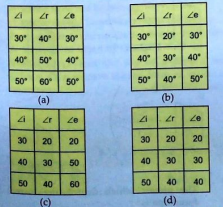
Four students reported the following observatio tables for the experiment to trace the path of a ray of light pasing through a glass slab for different angle of incidence. The observation liekly to be correct are those of student.

Promotional Banner

Topper's Solved these Questions

  • REFLECTION AND REFRACTION

    MODERN PUBLICATION|Exercise EXAMPLE|138 Videos
  • MAGNETIC EFFECTS OF ELECTRIC CURRENT

    MODERN PUBLICATION|Exercise EXERCISE|265 Videos
  • SOURCES OF ENERGY

    MODERN PUBLICATION|Exercise EXAMPLE|92 Videos

Similar Questions

Explore conceptually related problems

When a ray of light passes through a parallel slab of transport medium, then show that angle of incidence is equal to angle of emergence.

Draw a ray diagram to show the refraction of light through a glass prism. Hence obtain the relation for the angle of deviation in terms of the angle of incidence, angle of emergence and the angle of the prism.

A ray of light passing through an equilateral traingular glass prism from air undergoes minimum deviation,when angle of incidence is 3//4 of the angle of prism.Clculate the speed of light in the prism.

In these question, a statement of asertion followed by a statement of reason is given .Choose the correct answer out of the following choices: Assertion and reason both are correct statements and reason is correct explanation for assertion. Assertion and reason both are correct statements but reason is not correct explanation for assertion. Assertion is correct statement but reason is wrong statement. Assertion is wrong statement and reason is also false statement. Assertion:In Young's double slit experiment ,the fringe width for dark fringes is different from that for white fringes. Reason:In Young's double slit experimnet performed witha source of white light ,only black and bright fringes are observed.

Calculate the critical angle for a glass-air surface,if a ray of light which is incident in air on the surface is deviated through 15^@ ,when its angle of incidence is 40^@ .

A rectangular glass slab ABCD of refractive index n_1 is immersed in water of refractive index n2(n1ltn2) . A ray of light is incident at the surface AB of the slab as shwon. The maximum value of the angle of incidence alpha max such that the ray comes out from the other surface CD is given by .

A diverging beam of light from a point source S having divergence angle alpha , falls symmetrically on a glass slab as shown. The angles of incidence of the two extreme rays are equal. If the thickness of the glass slab is t and the refractive index n, then the divergence angle of the emergent beam is .

Three rays of light -red(R),green(G) and blue(B)-are incident on the face AB of a rigth-angled prism ABC as shown in Fig.3.27. The refractie indices of the material of the prism for red,green and blue wavelengths are 1.39,1.44 adn 1.47 respectively. Trace the path of the rays thruogh the prism.How will the situation change,if these rays were incident normally on one of the faces of an equilateral prism?

The existence of negatively charged particle in an atom was shown by J.J. Thomson as a result of the studies of the passage of electricity through gases at extremely low pressure known as discharge tube experiments. When a high voltage of the order of 10,000 volts or more was impressed across the electrodes, some sort of invisible rays moved from the negative electrode to the positive electrode these rays are called as cathode rays. Cathode rays travel in straight path in absence of electrical and magnetic field . Cathode rays consist of material part and charged particles? Cathode rays produce X-rays and light is emitted when they strike on ZnS screen. Cathode rays penetrate through thin sheets of aluminium and other metals . They affect the photogenic plate and passes heating effect when they strike on metal foil. The raito of charge to mass i.e charge/mass is same for all the cathode rays irrespective of the gas used in the tube. The existence of positively charged particle in an atom was shown be E. Goldstein. He repeated the same discharge tube experiments by using a perforated cathode. It was observed that when a high potential difference was applied between the electrodes, not only cathode rays were produced but also a new type of rays were produced simultaneoulsy from anode moving towards cathode and passes through the holes or canal of the cathode. These termed as canal rays or anode rays. These rays travel in straight lines and consists of positively charged particles. These rays have kinetic energy and produces heating effect also. The e/m ratio of these rays is smaller than that of electrons. Unlike cathode rays, their e/m value is dependent upon the nature of the gas taken in the tube. These rays produced flashes of light on ZnS screen and can pass throughs thin metal foils. They can produce physical and chemical changes and are capable to produce ionisation in gases. For cathode rays the value of e/m:

MODERN PUBLICATION-REFLECTION AND REFRACTION-EXAMPLE
  1. Four students reported the following observatio tables for the experim...

    Text Solution

    |

  2. A concave mirror of focal length 20 cm forms a real image at a distanc...

    Text Solution

    |

  3. A convex mirror used on an automobile has a radius of curvature of 3 m...

    Text Solution

    |

  4. An object 1 cm high is place on the axis and 15 cm from a concave mirr...

    Text Solution

    |

  5. The image formed by a concave mirror is half in size of the object. If...

    Text Solution

    |

  6. An object 5 cm high is placed at a distance of 10 cvm from a convex mi...

    Text Solution

    |

  7. When an object is placed at a distance of 60 cm from a convex spherica...

    Text Solution

    |

  8. Find the position of an object which when placed in front of a concave...

    Text Solution

    |

  9. An object is placed 10 cm from a concave mirror of radius of curvature...

    Text Solution

    |

  10. An object is placed 15 cm from a convex mirror of radius of curvature ...

    Text Solution

    |

  11. A 4.5 cm needle is placed 12 cm away from a convex mirror of focal len...

    Text Solution

    |

  12. What is the speed of light?

    Text Solution

    |

  13. If refractive index of glass w.r.t. air is 1.55, then what is the refr...

    Text Solution

    |

  14. The refractive index of water is 4/3 and flint glass is 1.65. What is ...

    Text Solution

    |

  15. A ray of light passes from to air to glass at an angle of incidence of...

    Text Solution

    |

  16. Monochromatic light of wavelength 589 nm is incident from air on a wat...

    Text Solution

    |

  17. The refractive index of diamond is 2.42 and that of glass is 1.5. find...

    Text Solution

    |

  18. A ray of light of frequency of 5 xx 10^(14)Hz is passed through a liqu...

    Text Solution

    |

  19. Velocity of light in a medium is 1.5xx10^8 ms^-1. Find the refractive ...

    Text Solution

    |

  20. The refractive index of diamond is:

    Text Solution

    |

  21. A ray of light passes from air to glass. The glass of incidence is 45^...

    Text Solution

    |