A
B
C
D
Text Solution
Verified by Experts
The correct Answer is:
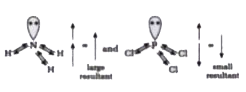 `BF_3` and `SO_3` are non-polar.


Topper's Solved these Questions
CHEMICAL BONDING
BRILLIANT PUBLICATION|Exercise LEVEL-II (ASSERTION-REASON TYPE)|20 VideosCHEMICAL BONDING
BRILLIANT PUBLICATION|Exercise QUESTIONS|6 VideosCHEMICAL BONDING
BRILLIANT PUBLICATION|Exercise LEVEL-I|120 VideosCHEMICAL AND IONIC EQUILIBRIUM
BRILLIANT PUBLICATION|Exercise Level - III (Linked Comprehension Type Questions)|1 VideosCHEMICAL BONDING AND MOLECULAR STRUCTURE
BRILLIANT PUBLICATION|Exercise QUESTION (LEVEL -ll)|42 Videos
Similar Questions
Explore conceptually related problems
BRILLIANT PUBLICATION-CHEMICAL BONDING-LEVEL-II
- Hybridization, shape and number of pi bonds in XeOF2 molecule are, res...
Text Solution
|
- Which of the following pairs of atoms combine to give non directional ...
Text Solution
|
- Which one of the following molecules has the largest dipole moment? (E...
Text Solution
|
- Which of the following molecules form no intermolecular hydrogen bonds...
Text Solution
|
- In hydrocarbon C3Hm, C-C-C bond angle is 120^@. The value of 'm' must ...
Text Solution
|
- Which of the following statements are correct? 1) The N atoms are cl...
Text Solution
|
- Which species contain sigma covalent, pi(pi)-covalent, coordinate cova...
Text Solution
|
- The boiling points of F2, Cl2, Br2 and I2 increase in that order. This...
Text Solution
|
- All of the following lists include at least one ionic compound except
Text Solution
|
- When forming covalent bonds which atom can have more than eight valenc...
Text Solution
|
- The geometries of the molecules BF3 and NF3 are trigonal planar and tr...
Text Solution
|
- All of the following molecules have their atoms lying in the same plan...
Text Solution
|
- CO2 is a gas at room temperature while SiO2 is a high melting solid. T...
Text Solution
|
- The nitrite ion NO2^(-) may be respresented by two major resonance for...
Text Solution
|
- Among the following species, identify the isostructural pairs : NF3, N...
Text Solution
|
- Arrange the following compounds in the order of increasing dipole mome...
Text Solution
|
- The cyanide ions CN^(ѳ) and N2 are isoelectronic, but in contrast to C...
Text Solution
|
- The correct order of hybridisation of the central atom in the followin...
Text Solution
|
- The common features among the species CN^(ѳ), CO and NO^(o+) are : ...
Text Solution
|
- The percentage of 'p character in the orbitals forming P-P bonds in 'P...
Text Solution
|