Home
Class 12
CHEMISTRY
With the help of polarity of the carbon ...

With the help of polarity of the carbon halogen bond show that aryl halides are less reactive than alkyl halides.

Text Solution

Verified by Experts
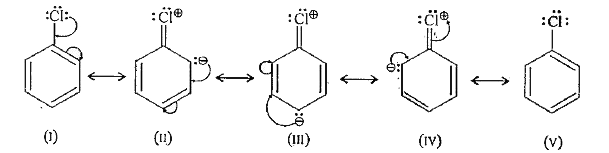
Hydrolysis of alkyl or aryl halides is a nucleophilic substitution reaction. The lesser reactivity of haloarenes (say chlorobenzene) than haloalkanes (say chloromethane) in nucleophilic substitution reactions can be explained as follows: (i) Resonance effect: Haloarenes are resonance stabilised, For example, chlorobenzene is a resonance. hybrid of various contributing structures (I) to (V) as shown below:

As a result of resonance, in structure (IT) to (IV), C-Cl bond acquires some double bond character. On the other hand, no such resonance occurs in alkyl halides. Therefore, C-Cl bond in aryi halides is stronger than carbon-halogen bond in haloalkanes and hence can not be easily broken, so chlorobenzene is less reactive. (ii) Hybridisation of carbon bearing the halogen atom. In haloalkanes, the carbon atom attached to the halogen atom (C--X). is `sp^3` -hybridised whereas in haloarenes, the carbon atom attached to the halogen atom is `sp^2`-hybridised. Now `sp^2`-hybrid orbital of carbon is slightly smaller in size than the `sp^3`-hybrid orbital. Therefore, the nalogen bond in haloarenes is shorter and stronger than the carbon-halogen bond in haloalkanes. This also justify the low reactivity of haloarenes as compared to haloalkanes
Promotional Banner

Topper's Solved these Questions

  • GENERAL PRINCIPLES AND PROCESS OF ISOLATION OF ELEMENTS

    BETTER CHOICE PUBLICATION|Exercise Question Bank (6.6 OXIDATION-REDUCTION)|15 Videos
  • ORGANIC COMPOUND WITH FUNCTIONAL GROUP CONTANING OXYGEN-II

    BETTER CHOICE PUBLICATION|Exercise Question Bank (12.9 Uses of Carboxylic Acids)|4 Videos

Similar Questions

Explore conceptually related problems

With the help of hybridisation show that aryl halides are lesser reactive than alkyl halides.

With the help of resonance show that aryl halides are lesser reactive than alkyl halides.

In general, alkyl halides are more reactive than aryl halides.

Why aryl halide(haloarenes) are less reactive than alkyl halide(haloalkanes)?

Why is benzene. less reactive than cyclohexane ?

Give reasons : Alkyl halides are better solvents than aryl halides.

BETTER CHOICE PUBLICATION-HALOALKANES AND HALOARENES-QUESTIONS
  1. What are ambident uncleophiles ? Explain with an example.

    Text Solution

    |

  2. Alkyl Chloride is more reactive than chlorobenzene towards nucleophili...

    Text Solution

    |

  3. With the help of polarity of the carbon halogen bond show that aryl ha...

    Text Solution

    |

  4. Why are haloarenes more stable than haloalkanes ?

    Text Solution

    |

  5. Why do alkyi haldies undergo hydrolysis more readily than aryl halides...

    Text Solution

    |

  6. With the help of resonance show that aryl halides are lesser reactive ...

    Text Solution

    |

  7. With the help of hybridisation show that aryl halides are lesser react...

    Text Solution

    |

  8. With the help of polarity of the carbon halogen bond show that aryl ha...

    Text Solution

    |

  9. Why does electrophilic substitution take place at ortho and para posit...

    Text Solution

    |

  10. Why does electrophilic substitution take place at ortho and para posit...

    Text Solution

    |

  11. Haloarene is ortho and para directing Explain.

    Text Solution

    |

  12. Write short notes on : Wurtz reaction

    Text Solution

    |

  13. Write Fittig reaction.

    Text Solution

    |

  14. Write short notes on : Friedel Craft's reaction

    Text Solution

    |

  15. Write Fittig reaction.

    Text Solution

    |

  16. Write Ullmann reaction.

    Text Solution

    |

  17. Write the following reactions : Friedel Craft alkylation.

    Text Solution

    |

  18. Name the reagent used to convert 1-chloroproane to 1- nitropropane.

    Text Solution

    |

  19. Name the reagent used to convert bromoethane to ether.

    Text Solution

    |

  20. Write a chemical reaction to illustrate Saytzeff's rule.

    Text Solution

    |

