Home
Class 12
CHEMISTRY
Although chlorine is an electron withdra...

Although chlorine is an electron withdrawing group, yet it is ortho-, para-directing in electrophilic aromatic substitution reaction. Why?

Text Solution

Verified by Experts
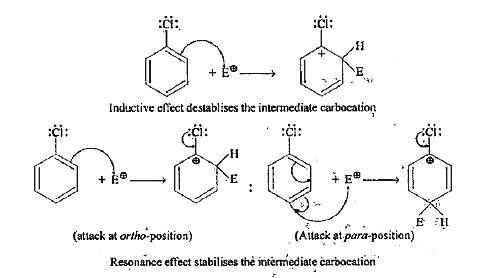
Chlorine withdraws electrons through inductive effect and releases electrons through resonance. Through inductive effect, chlorine destabilises the intermediate carbocation formed during the electrophilic substitution.

Through resonance halogen tends to stabilise the carbocation and the effect is, more pronouced at ortho-and para-positions. The inductive effect is stronger than resonance and causes net electron withdrawal and thus causes net deactivation. The resonance effect tends to oppose the inductive effect for the attack at ortho-and para- positions and hence makes the deactivation less for ortho- and para-attack. Reactivity is thus controlled by the stronger inductive effect and orientation is controlled by resonance effect.
Promotional Banner

Topper's Solved these Questions

  • GENERAL PRINCIPLES AND PROCESS OF ISOLATION OF ELEMENTS

    BETTER CHOICE PUBLICATION|Exercise Question Bank (6.6 OXIDATION-REDUCTION)|15 Videos
  • ORGANIC COMPOUND WITH FUNCTIONAL GROUP CONTANING OXYGEN-II

    BETTER CHOICE PUBLICATION|Exercise Question Bank (12.9 Uses of Carboxylic Acids)|4 Videos

Similar Questions

Explore conceptually related problems

Although chlorine is an electron withdrawing group, yet it is ortho-, para-directing in electrophilic aromatic substitution reactions. Why ?

Amino group in aniline is o, p-directing and activating in electrophilic substitution reactions.

Aldehyde group is o, p-directing and activating in electrophilic substituion reactions of aromatic aldehydes.

The presence of electron withdrawing group increases the reactivity of haloarenes towards nuncleophilic substitution reaction. Explain.

Acylation of — NH_2 group in aniline reduces its reactivity in electrophilic substitution reactions.

Why -OH group in phenol is ortho and para directing in nature ?

Explain the fact that in aryl ethers (i) the alkoxy group activates the benzene ring towards electrophilic substitution and (ii) it directs the incoming substituents to ortho -and para -positions in benzene ring .

BETTER CHOICE PUBLICATION-HALOALKANES AND HALOARENES-QUESTIONS
  1. Allyl choride is more reactive than r-propyl chloride towards nucleoph...

    Text Solution

    |

  2. Haloalkanes react with potassium cyanide (KCN) to give alkyl cyanide, ...

    Text Solution

    |

  3. Although chlorine is an electron withdrawing group, yet it is ortho-, ...

    Text Solution

    |

  4. How will you convert the following : Isopropylbromide to Propene

    Text Solution

    |

  5. How will you convert the following : Bromoethane to iodoethane.

    Text Solution

    |

  6. How will you convest the following: Chlorobencene to Aniline

    Text Solution

    |

  7. How will you convest the following: Aniline to Fluorobencene

    Text Solution

    |

  8. How will you convert. Anline into chlorobenzene.

    Text Solution

    |

  9. Complete the following reaction : CH3 CH2 Br + Ag CN to

    Text Solution

    |

  10. How will you convert Ethylbromide to Ethylisocyanide.

    Text Solution

    |

  11. Give chemical test to distinguish between following pair of compounds.

    Text Solution

    |

  12. Give chemical test to distinguish between following pair of compounds....

    Text Solution

    |

  13. Give chemical test to distinguish between following pair of compounds....

    Text Solution

    |

  14. How will you differentiate between S(N^1) and S(N^2) reaction mechanis...

    Text Solution

    |

  15. What are freons ?

    Text Solution

    |

  16. Write two environmental effects of dichloromethane.

    Text Solution

    |

  17. Give two uses of chloroform.

    Text Solution

    |

  18. Why the use of chloroform as anesthetic is decreasing ?

    Text Solution

    |

  19. Give one use of freon.

    Text Solution

    |

  20. Iodoform gives a precipitate with AgNO3. Why ?

    Text Solution

    |

