Home
Class 12
CHEMISTRY
Explain with example S(N^1) mechanism....

Explain with example `S_(N^1)` mechanism.

Text Solution

Verified by Experts
`SN^(1)` reactions (Substitution Nuclephilic Unimolecular reactions) are those reactions which take place in two consecutive steps. The rate of the reaction depends only on the concentration of alkyl halide and is independent of the concentration of nucleophile. For example consider the action of nucleophile on alkyl halide.
` R -X + bar(N)u to underset("Rate" alpha"[Alkyl halide]")(R -Nu + : bar(X))`
Thus `SN^(1)` reactions show first order-kinetic. Let us consider the hydrolysis of tețitary butyl bromide with hydroxide ion.
`underset("tert-Butyl alcohol")( (CH_3)_3 C - Br + : bar(O)H to underset("tert-Butyl alcohol")((CH_3)_3 C-OH + bar(B)r)`
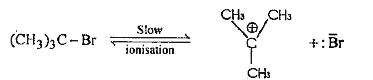
Mechanism : It is a unimolecular reaction and occurs in two steps. Step 1. Formation of carbocation.

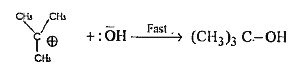
This step is slow and hence is the rate-determining step of the reaction. Step II. Attack of nucleophile on carbocation. The carbocation formed in step! readily combines with nucleophile `(:barO H)` to form tertiary butylalcohol.

This step is fast and hence does not affect the rate of the reaction. Kinetics : Since the selfionisation of tertiary butylbromide is the slowest step of the reaction i.e., the rate determining step, therefore, it shows first order kinetic. In other words, the rate of reaction depends upon the concentration of tert-butyl bromide only.
Rate `mu [(CH_3)_3 C-Br]`
Rate `=K[(CH_3)_3 C-Br]`
All tertiary aikyl halides undergo substitution by `SN^(1)` mechanism
Promotional Banner

Topper's Solved these Questions

  • GENERAL PRINCIPLES AND PROCESS OF ISOLATION OF ELEMENTS

    BETTER CHOICE PUBLICATION|Exercise Question Bank (6.6 OXIDATION-REDUCTION)|15 Videos
  • ORGANIC COMPOUND WITH FUNCTIONAL GROUP CONTANING OXYGEN-II

    BETTER CHOICE PUBLICATION|Exercise Question Bank (12.9 Uses of Carboxylic Acids)|4 Videos

Similar Questions

Explore conceptually related problems

Explain with examples : Mass number

Explain with examples : Isotopes

Explain with examples : Isobars.

Explain with examples : Atomic number

Explain SN^2 mechanism ?

Explain with example: Detergents.

Explain the reactivity of SN^2 mechanism ?

BETTER CHOICE PUBLICATION-HALOALKANES AND HALOARENES-QUESTIONS
  1. How is DDT prepared from chlorobenzene ? Give the chemical equation on...

    Text Solution

    |

  2. Give the reaction chloroform with alcoholic KOH.

    Text Solution

    |

  3. Explain with example S(N^1) mechanism.

    Text Solution

    |

  4. How tert-butyl bromide reacts with aqueous KOH ? Give the mechanism an...

    Text Solution

    |

  5. Explain SN^2 reactions. What is the preference order of different alky...

    Text Solution

    |

  6. How tert-butyl bromide reacts with aqueous KOH ? Give the mechanism an...

    Text Solution

    |

  7. Give the mechanism of substitution nucleophilic bimolecular, SN^2 reac...

    Text Solution

    |

  8. How tert-butyl bromide reacts with aqueous KOH ? Give the mechanism an...

    Text Solution

    |

  9. How does chlorobenzene reacts with the following: Sodium

    Text Solution

    |

  10. How does chlorobenzene reacts with the following: H2 SO4

    Text Solution

    |

  11. How does chlorobenzene react with : Mg.

    Text Solution

    |

  12. How does chlorobenzene reacts with the following: KCl2

    Text Solution

    |

  13. How does chlorobenzene react with: Lithium

    Text Solution

    |

  14. How does chlorobenzene react with: HNO3

    Text Solution

    |

  15. What happens when : Chlorobenzene is treated with CH3Cl in the prese...

    Text Solution

    |

  16. Explain the following reactions : Nitration of haloarenes.

    Text Solution

    |

  17. How does chlorobenzene react with sodium in the presence of ether ? Wh...

    Text Solution

    |

  18. How does chlorobenzene react with : Mg.

    Text Solution

    |

  19. How does chlorobenzene react with : Cl2.

    Text Solution

    |

  20. How does iodobenzene react with copper powder in a sealed tube ? What ...

    Text Solution

    |