Home
Class 12
CHEMISTRY
The presence of electron withdrawing gro...

The presence of electron withdrawing group increases the reactivity of haloarenes towards nuncleophilic substitution reaction. Explain.

Text Solution

Verified by Experts
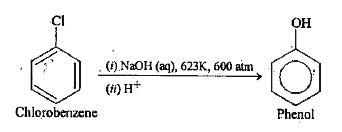
Chlorobenzene can be converted into phenol by heating in aqueous NaOH at 623K and under a pressure of 300 atmosphere.

However in the presence of electron withdrawing group `(-NO_2)` at-o and p-positions the same hydrolysis can be carried out by warming with water only

This is because the electron withdrawing groups at o and p-positions stabilises the intermediate carbanion by resonance. However, no effect on reactivity of haloarenes is obeserved if the electron withdrawing group in present at m-position because in that case resonance stablisation of carbanion in not possible. This is clear from the mechanism of the reaction explained below.

As shown, the presence of `-NO_2` group at o and p-positions withdraws the electrons density from the benzene ring and thus lielps in the attack of nucleophile on haloarenes. The carbonian so formed is resonance stabilised. The -ve charge appeared at o and.p-positions w.rt. halogen is stabilised by `-NO_2` group. While in case of m-nitrochlorobenzene none of the resonating structure, bears the -ve charge an carbon atom bearing the `-NO_2` group. Therefore, the presence of `-NO_2` group at m-position does not disperse the-ve charge and no effect an reactivity is observed by the presence of `-NO_2` group at m-position
Promotional Banner

Topper's Solved these Questions

  • GENERAL PRINCIPLES AND PROCESS OF ISOLATION OF ELEMENTS

    BETTER CHOICE PUBLICATION|Exercise Question Bank (6.6 OXIDATION-REDUCTION)|15 Videos
  • ORGANIC COMPOUND WITH FUNCTIONAL GROUP CONTANING OXYGEN-II

    BETTER CHOICE PUBLICATION|Exercise Question Bank (12.9 Uses of Carboxylic Acids)|4 Videos

Similar Questions

Explore conceptually related problems

Why haloalkanes are more reactive than haloarenes towards nuclophilic subsition reaction ?

Benzyl chloride is more reactive than chlorobenzene towards nucleophilic substitution. Explain.

Alkyl Chloride is more reactive than chlorobenzene towards nucleophilic substitution. Explain.

Aryl halide are less reactive than alkyl halides towards nucleophilic substitution reactions. Why ?

Allyl chloride is more reactive than n-propyl chloride towards nucleophilic substitution reaction. Explain why ?

Which of the following is most reactive towards nucleophilic substitution reaction ?

Allyl choride is more reactive than r-propyl chloride towards nucleophilic substiution reaction. Explain why ?

Which of the following will be least reactive towards nucleophilic substitution reaction ?

Which of the following will be least reactive towards nucleophilic substitution reaction ?

BETTER CHOICE PUBLICATION-HALOALKANES AND HALOARENES-QUESTIONS
  1. Why is Wurtz reaction not suitable for the preparation of odd number a...

    Text Solution

    |

  2. Benzyl chloride is more reactive than chlorobenzene towards nucleophil...

    Text Solution

    |

  3. Write the following reactions : Carbylamine reaction.

    Text Solution

    |

  4. Write following name reactions : Riemer Tiemann reactioin.

    Text Solution

    |

  5. Explain the following : Hoffmann amonolysis

    Text Solution

    |

  6. Write the following reactions : Williamson’s synthesis

    Text Solution

    |

  7. Explain the following reactions: Diazotisation reaction.

    Text Solution

    |

  8. Alkyl halides are amongst the most reactive of the organic compounds. ...

    Text Solution

    |

  9. Alkyl halides are regarded as synthetic tools in the hands of a chemis...

    Text Solution

    |

  10. How do the products differ when ethyl bromide reacts separately with a...

    Text Solution

    |

  11. What is the purpose of anhydrous ZnCl2 in the preparation of haloalkan...

    Text Solution

    |

  12. What happens when : Ethyl chloride is treated with (aq) KOH.

    Text Solution

    |

  13. What happens when : Methyl chloride is treated with KCN.

    Text Solution

    |

  14. Methyl bromide is treated with sodium in the presence of dry ether.

    Text Solution

    |

  15. What happens when : n-butyl chloride is treated with alcoholic KOH.

    Text Solution

    |

  16. What happens when an ethyl bromide reacts with : Ag NO2

    Text Solution

    |

  17. What happens when an ethyl bromide reacts with : Ag CN (alc.) ?

    Text Solution

    |

  18. Haloalkanes undergo nucleophilic substitution reactions while haloaren...

    Text Solution

    |

  19. How aryl halides react with sodium metal? Explain why alkyl halides sh...

    Text Solution

    |

  20. The presence of electron withdrawing group increases the reactivity of...

    Text Solution

    |