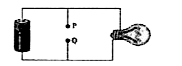
Brad sets up an electrical circuit as shown in the figure. He connects points P and Q of the circuit with four different rods made of four different materials - glass, wood, copper, and asbestos. The bulb in the circuit will not light up when points P and Q are connected with
A
Glass rod
B
Wood rod
C
Copper rod
D
Asbestos rod
Text Solution
Verified by Experts
Topper's Solved these Questions
ELECTRICITY
BEIITIANS|Exercise Conceptive Worksheet|18 Videos
ELECTRICITY
BEIITIANS|Exercise Summative Worksheet|11 Videos
ENERGY AND WORK
BEIITIANS|Exercise IIT JEE WORKSHEET |34 Videos
Similar Questions
Explore conceptually related problems
Brad sets up an electrical circuit as shown in the given figure. He connects points P and Q of the circuit with four different rods made of four different materials - glass, wood, copper, and asbestos. The bulb in the circuit will not light up when points P and Q are connected with
Tommy sets up an electrical circuit as shown in the figure. He connects points P and Q with different materials. The bulb will light up when points P and Q are connected by a plate made of
Tommy sets up an electrical circuit as shown in the figure. He connects points P and Q with different materials. The bulb will light up when points P and Q are connected by a plate made of
There is a electric circuit as shown in the figure. Find potential difference between points a and b.
The net resistance between points P and Q in the circuit shown in figure is
The equivalent resistance between the points P and Q of the circuit given is
The effective resistance between points P and Q of the electrical circuit shown in the figure is :
The effective resistance between points P and Q of the electrical circuit shown in the figure is
The effective resistance between points P and Q of the electrical circuit shown in the figure is
The potential difference between points a and b of circuits shown in figure is
BEIITIANS-ELECTRICITY -IIT JEE Worksheet V. Matrix Matching