Home
Class 10
CHEMISTRY
Four students A,B,C and D noted the init...

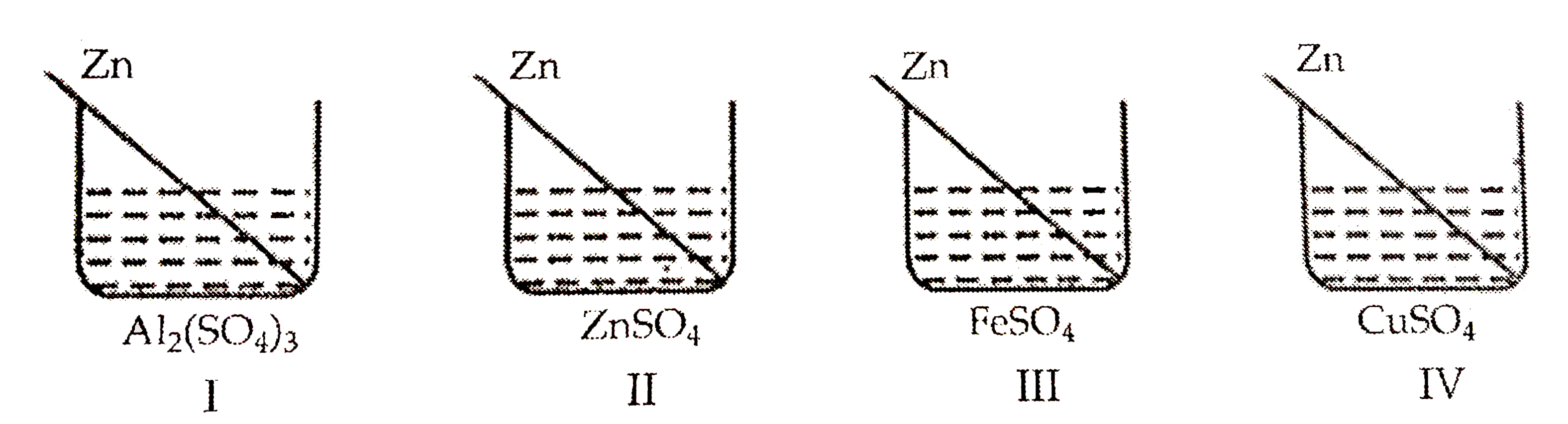
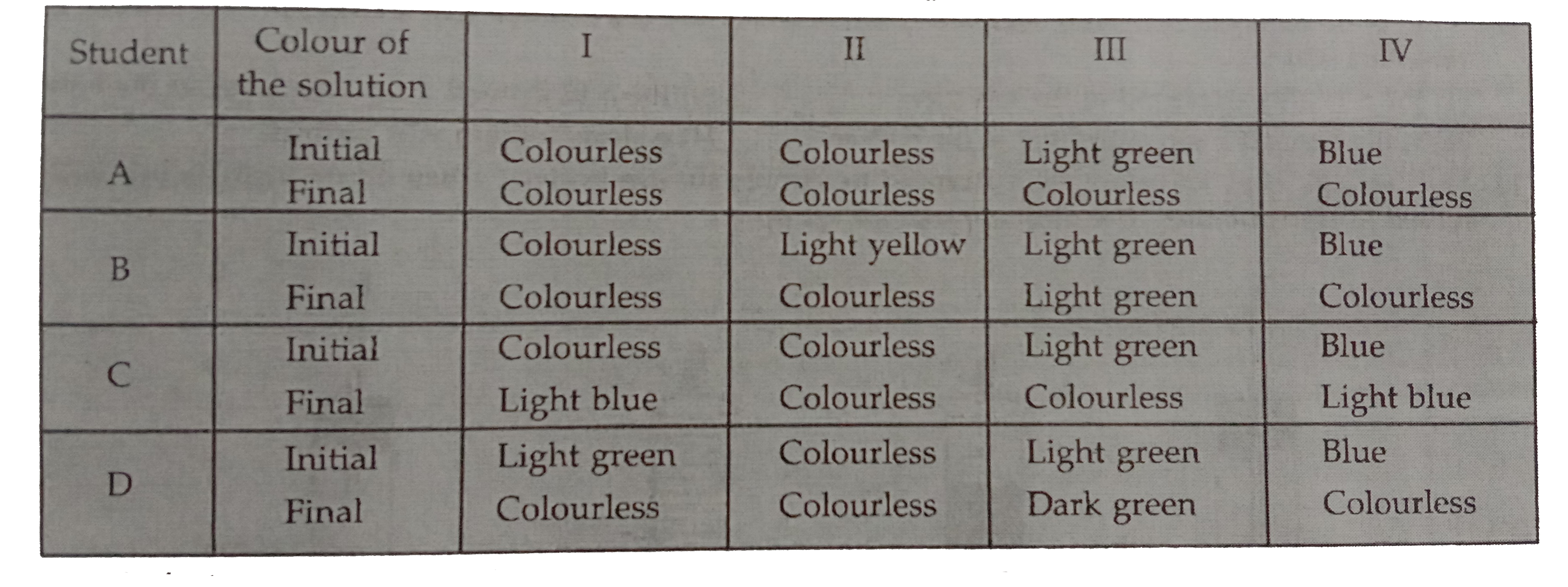
Four students A,B,C and D noted the initial colour of the solutions in beakers I, II, III and IV. After inserting zinc rods in each solution and leaving it undisturbed for two hours, noted the colour of each solution again.

They recorded their observations in thr form of a table given below:

Which student noted the colour change in all four beakers correctly?

A

P

B

Q

C

R

D

S

Text Solution

Verified by Experts

The correct Answer is:

D

The reactivity of metals is in the order :
`AlgtZngtFegtCu`
Thus, in beaker I, no reaction takes place, colourless solution remains colourless.
In beaker II, no reaction takes place.
In beaker III, reaction takes place as follows:
`Zn+underset(("Light green"))(FeSO_(4))tounderset(("Colourless"))(ZnSO_(4))+Fe`
In beaker IV, reaction takes place as follows:
`Zn+underset(("Blue"))(CuSO_(4))tounderset(("Colourless"))(ZnSO_(4))+Cu`
Promotional Banner

Topper's Solved these Questions

  • CHEMICAL REACTIONS AND EQUATIONS

    MTG IIT JEE FOUNDATION|Exercise EXERCISE (INTEGER/NUMERICAL VALUE TYPE)|5 Videos
  • CHEMICAL EQUILIBRIUM

    MTG IIT JEE FOUNDATION|Exercise EXERCISE (INTEGER/NUMERICAL VALUE TYPE)|5 Videos
  • FOOTSTEPS TOWARDS (NEET)

    MTG IIT JEE FOUNDATION|Exercise MCQ|45 Videos

Similar Questions

Explore conceptually related problems

Four students A, B, C, and D took aqueous solutions of zinc sulphate and iron sulphate in two test tubes I and II and dropped metal pieces of Iron and Zinc in the two solutions. After several hours, they made observations and recorded their findings in the form of a table given below: Who reported the correct observation?

Aluminium sulphate and copper sulphate solutions were taken in two test tubes I and II respectively. Iron filings were then addd to both the solutions. The four students A,B, C and D recorded their observations in the form of a table as given on the next page. The correct set of observations have been recorded by the student:

Four students A,B,C and D were asked by their teacher to arrange the set up I to IV as given below and identify the gas, if any evolved in each case: After observations the students arrived at the inferences recorded in the following table: The correct observations and inferences have been reported by the student:

Four students (A),(B),(C) and (D) observed the colour and solubility of iron, sulphur and iron, sulphur and iron sulphide in carbon disulphide. The tick mark represents soluble and cross mark represents insoluble, in carbon disulphide. Their observation are tabulated below The student who correctly reported the observations, is student :

For students A,B,C and D were studying the effect of the solutions of hydrochloric acid, sodium hydroxide, sodium chloride and pure water respectively on the blue litmus solutioin. Which of the students observed the colour change of blue litmus solution to red?

A student takes Cu, Al, Fe and Zn piees separtely in four test tubes labelled as I,II, III and IV respectively. He adds 10mL of freshly prepared ferrous sulphate solution to each test tube observes the colour of the metal residue in each case. He would observe a black residue in the test tube:

MTG IIT JEE FOUNDATION-CHEMICAL REACTIONS AND EQUATIONS-OLYMPIAD/HOTS CORNER
  1. When you mix solutions of lead (II) nitrate and potassium iodide. (i...

    Text Solution

    |

  2. Mg+CuOtoMgO+Cu Which of the following is wrong relating to the above...

    Text Solution

    |

  3. Which of the following are exothermic processes? 1. Reaction of wate...

    Text Solution

    |

  4. In the double displacement reaction between aqueous potassium iodide a...

    Text Solution

    |

  5. Four students A,B,C and D noted the initial colour of the solutions in...

    Text Solution

    |

  6. For the given redox reaction : Identify p, q, r and s.

    Text Solution

    |

  7. Identify the type of reaction for each of the following as Combinati...

    Text Solution

    |

  8. Identify the correct oxidant and reductant in the following reaction :...

    Text Solution

    |

  9. The given reaction occurs in a car battery when it is used to produce ...

    Text Solution

    |

  10. Rohit and Mayuri conducted two experiments to study the types of chemi...

    Text Solution

    |

  11. Which one of the following reactions is not possible?

    Text Solution

    |

  12. Addition of HCl to an aqueous solution of Pb(NO(3))(2) gives a

    Text Solution

    |

  13. The equation, Mg((s))+CuO((s))toMgO((s))+Cu((s)) represents (A) Deco...

    Text Solution

    |

  14. The given diagram shows the energy levels of the reactants and product...

    Text Solution

    |

  15. The chemical reaction between quicklime and water is characterised by ...

    Text Solution

    |

  16. The chemical reactions and their corresponding observable features are...

    Text Solution

    |

  17. A science teacher wrote the following statements about rancidity: (i...

    Text Solution

    |

  18. Which one is an example of a redox reaction?

    Text Solution

    |

  19. Classify each of the following reactions.

    Text Solution

    |

  20. P, Q and R are three metals that undergo chemical reactions as follows...

    Text Solution

    |
