Home
Class 10
CHEMISTRY
The given diagram shows the energy level...

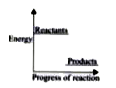
The given diagram shows the energy levels of the reactants and products for a particular reaction:

Which of the following processes can be related to the given diagram?

A

Ethyne gas burns in oxygen to form carbon dioxide and water along with evolution of heat.

B

When solid mercury (II) oxide is heated liquid mercury and oxygen gas are produced.

C

Hydrogen gas combines with chlorine gas in the presence of light to form hydrogen chloride gas.

D

Potassium chlorate decomposes in presence of heat to form potassium chloride and oxygen.

Text Solution

Verified by Experts

The correct Answer is:

A

In the given diagram, the energy of reactants is greater than products, thus, energy is released during the reaction i.e., the reaction is exothermic.
Ethyne gas burns in oxygen as:
`underset("Ethyne")(C_(2)H_(2))+underset("Oxygen")(5/2O_(2))tounderset("dioxide")underset("Carbon")(2CO_(2))+underset("Water")(H_(2)O)+"Heat"`
Whereas, all other given reactions consume heat or light.
Promotional Banner

Topper's Solved these Questions

  • CHEMICAL REACTIONS AND EQUATIONS

    MTG IIT JEE FOUNDATION|Exercise EXERCISE (INTEGER/NUMERICAL VALUE TYPE)|5 Videos
  • CHEMICAL EQUILIBRIUM

    MTG IIT JEE FOUNDATION|Exercise EXERCISE (INTEGER/NUMERICAL VALUE TYPE)|5 Videos
  • FOOTSTEPS TOWARDS (NEET)

    MTG IIT JEE FOUNDATION|Exercise MCQ|45 Videos

Similar Questions

Explore conceptually related problems

Which of the following process is correct for given P-V diagram.

Which of the following is correct regarding the given diagram ?

The given diagram shows the transportation of materials by

Take the given food chain into account Which of the following processes is depicted by the given arrow diagram?

Which of the following labels show the only repolarization wave in the given diagram ?

Which of the following is true for given diagram

MTG IIT JEE FOUNDATION-CHEMICAL REACTIONS AND EQUATIONS-OLYMPIAD/HOTS CORNER
  1. When you mix solutions of lead (II) nitrate and potassium iodide. (i...

    Text Solution

    |

  2. Mg+CuOtoMgO+Cu Which of the following is wrong relating to the above...

    Text Solution

    |

  3. Which of the following are exothermic processes? 1. Reaction of wate...

    Text Solution

    |

  4. In the double displacement reaction between aqueous potassium iodide a...

    Text Solution

    |

  5. Four students A,B,C and D noted the initial colour of the solutions in...

    Text Solution

    |

  6. For the given redox reaction : Identify p, q, r and s.

    Text Solution

    |

  7. Identify the type of reaction for each of the following as Combinati...

    Text Solution

    |

  8. Identify the correct oxidant and reductant in the following reaction :...

    Text Solution

    |

  9. The given reaction occurs in a car battery when it is used to produce ...

    Text Solution

    |

  10. Rohit and Mayuri conducted two experiments to study the types of chemi...

    Text Solution

    |

  11. Which one of the following reactions is not possible?

    Text Solution

    |

  12. Addition of HCl to an aqueous solution of Pb(NO(3))(2) gives a

    Text Solution

    |

  13. The equation, Mg((s))+CuO((s))toMgO((s))+Cu((s)) represents (A) Deco...

    Text Solution

    |

  14. The given diagram shows the energy levels of the reactants and product...

    Text Solution

    |

  15. The chemical reaction between quicklime and water is characterised by ...

    Text Solution

    |

  16. The chemical reactions and their corresponding observable features are...

    Text Solution

    |

  17. A science teacher wrote the following statements about rancidity: (i...

    Text Solution

    |

  18. Which one is an example of a redox reaction?

    Text Solution

    |

  19. Classify each of the following reactions.

    Text Solution

    |

  20. P, Q and R are three metals that undergo chemical reactions as follows...

    Text Solution

    |
