Home
Class 10
CHEMISTRY
In the reaction, Br(2) +2I^(-) to 2Br^(-...

In the reaction, `Br_(2) +2I^(-) to 2Br^(-) +I_(2)`, the oxidising agent is

A

`Br_(2)`

B

`I^(-)`

C

`Br^(-)`

D

`I_(2)`

Text Solution

Verified by Experts

The correct Answer is:
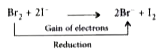
A


The substance which undergoes reduction is an oxidising agent.
Promotional Banner

Topper's Solved these Questions

  • CHEMICAL REACTIONS AND EQUATIONS

    MTG IIT JEE FOUNDATION|Exercise OLYMPIAD/HOTS CORNER|20 Videos
  • FOOTSTEPS TOWARDS (JEE MAIN)

    MTG IIT JEE FOUNDATION|Exercise Integer/Numerical Value Type|5 Videos

Similar Questions

Explore conceptually related problems

In the reaction 2Br^(-) + X_2 to Br_2 + 2X^(-) , X_2 is

For the reaction, H_(2(g)) + Br_(2(g)) to 2HBr_((g)) , the reaction rate = k [H_(2)][Br_(2)]^(1//2) . Which statement is true about this reaction?

Consider the following half cell reactions : Br_(2) + 2e^(-) to 2 Br^(-) " " E^(@) = 1.09 V I_(2) + 2e^(-) to 2 I^(-) " " E^(@) = 0.54 V If I_(2) and Br_(2) are added to solution containing 1 M concentration of I^- and Br^- respectively . How will the increase in the concentration of Br^(-) affect E_(cell) ?

Question 1 and 2 should be answered using the unbalanced equation, ClO_(3)^(-)+Br^(-) to Cl_(2)+Br_(2) Which is the reducing agent?

For the reaction H_(2)(g) + Br_(2)(g) rarr 2HBr (g) the experimental data suggested that r = k[H_(2)][Br_(2)]^(1//2) The molecularity and order of the reaction are respectively:

The reaction 2NO + Br_(2) to 2NOBr , obeys the following mechanism: NO + Br_(2) overset("fast")(hArr) NOBr_(2), NOBr_(2) + NO overset("Slow")(to) 2NOBr The rate expression of the above reaction can be written as

Bromine is commercially prepared from sea water by displacement reaction Cl_(2)+2Br^(-)(aq) to 2Cl^(-)(aq)+Br_(2) Br_(2) gas thus formed is dissolved into solution of Na_(2)CO_(3) and then pure Br_(2) is obtained by treatment of the solution with:

Bromine is commercially prepared from sea water by displacement reaction Cl_(2)+2Br^(-)(aq.)to2Cl^(-)(aq.)+Br_(2) Br_(2) gas thus formed is dissolved into solution of Na_(2)CO_(3) and then pure Br_(2) iis obtained by treatment of the solution with :

MTG IIT JEE FOUNDATION-FOOTSTEPS TOWARDS (NEET) -MCQ
  1. Which of the following is correct order of the reactivity of the metal...

    Text Solution

    |

  2. A student takes about 5 mL distilled water in four test tubes marked P...

    Text Solution

    |

  3. In the reaction, Br(2) +2I^(-) to 2Br^(-) +I(2), the oxidising agent ...

    Text Solution

    |

  4. An experiment was carried out using the apparatus shown below: ...

    Text Solution

    |

  5. Which of the following elements is not a metal?

    Text Solution

    |

  6. When 1.0 mol of compound Q is burnt in excess oxygen, 2.0 mol of carbo...

    Text Solution

    |

  7. Which of the following statements is correct about elements ""(9)^(19)...

    Text Solution

    |

  8. Observe the given figure and answer the question that follows: ...

    Text Solution

    |

  9. Acids like lactic acid, uric acid which are obtained usually from plan...

    Text Solution

    |

  10. Arrange the following atoms in the order of increasing atomic radius :...

    Text Solution

    |

  11. Electrolytic reduction method is used in the extraction of

    Text Solution

    |

  12. The given diagram represents a reaction.

    Text Solution

    |

  13. Change of Na(2)CO(3).10H(2)O to Na(2)CO(3).H(2)O on exposure to air is...

    Text Solution

    |

  14. The structural formulae of compounds Q and R are shown below: W...

    Text Solution

    |

  15. The liquid non-metal is

    Text Solution

    |

  16. Which of the following elements will form an acidic oxide?

    Text Solution

    |

  17. Consider the following reaction: (I) and (II) are respectively

    Text Solution

    |

  18. Moist sodium bicarbonate was placed on a strip of pH paper. The colour...

    Text Solution

    |

  19. Which of the following pairs of compounds have similar chemical proper...

    Text Solution

    |

  20. Which one of the following types of ores can be converted into oxide b...

    Text Solution

    |

