Home
Class 10
CHEMISTRY
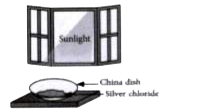
Observe the given figure and answer the ...

Observe the given figure and answer the question that follows:

State True (T) or False (F) for the following statements.
(i) It is a photodecomposition reaction.
(ii) Silver chloride turns grey in sunlight to form silver metal.
(iii) It is an exothermic reaction.
(iv) Silver bromide also behaves in the same way and used in black and white photography.

A

`{:("(i)","(ii)","(iii)","(iv)"),(T,T,T,T):}`

B

`{:("(i)","(ii)","(iii)","(iv)"),(T,F,T,F):}`

C

`{:("(i)","(ii)","(iii)","(iv)"),(T,F,F,T):}`

D

`{:("(i)","(ii)","(iii)","(iv)"),(T,T,F,T):}`

Text Solution

Verified by Experts

The correct Answer is:

D

White silver chloride turns grey in sunlight due to the decomposition of silver chloride into silver and chlorine by light. It is an endothermic reaction.
`underset("Silver chloride")(2AgCl_((s))) overset("Sunlight")to underset("Silver (grey)")(2Ag_((s)))+underset("Chlorine")(Cl_(2(g)))`
`underset("Silver bromide")(2AgBr_((s))) overset("Sunlight")to underset("Silver")(2Ag_((s))) +underset("Bromine")(Br_(2(g)))`
Promotional Banner

Topper's Solved these Questions

  • CHEMICAL REACTIONS AND EQUATIONS

    MTG IIT JEE FOUNDATION|Exercise OLYMPIAD/HOTS CORNER|20 Videos
  • FOOTSTEPS TOWARDS (JEE MAIN)

    MTG IIT JEE FOUNDATION|Exercise Integer/Numerical Value Type|5 Videos

Similar Questions

Explore conceptually related problems

Why does silver chloride turn grey in sunlight ?

Silver chloride turns grey on exposure to sunlight for a long duration due to:

White silver chloride in sunlight turns to

state the condition in which a sample of silver chloride gets decomposed to form silver.

What change will you observe if white silver chloride is placed in sunlight? Write an equation for the reaction and the type of the reaction.

MTG IIT JEE FOUNDATION-FOOTSTEPS TOWARDS (NEET) -MCQ
  1. An experiment was carried out using the apparatus shown below: ...

    Text Solution

    |

  2. Which of the following elements is not a metal?

    Text Solution

    |

  3. When 1.0 mol of compound Q is burnt in excess oxygen, 2.0 mol of carbo...

    Text Solution

    |

  4. Which of the following statements is correct about elements ""(9)^(19)...

    Text Solution

    |

  5. Observe the given figure and answer the question that follows: ...

    Text Solution

    |

  6. Acids like lactic acid, uric acid which are obtained usually from plan...

    Text Solution

    |

  7. Arrange the following atoms in the order of increasing atomic radius :...

    Text Solution

    |

  8. Electrolytic reduction method is used in the extraction of

    Text Solution

    |

  9. The given diagram represents a reaction.

    Text Solution

    |

  10. Change of Na(2)CO(3).10H(2)O to Na(2)CO(3).H(2)O on exposure to air is...

    Text Solution

    |

  11. The structural formulae of compounds Q and R are shown below: W...

    Text Solution

    |

  12. The liquid non-metal is

    Text Solution

    |

  13. Which of the following elements will form an acidic oxide?

    Text Solution

    |

  14. Consider the following reaction: (I) and (II) are respectively

    Text Solution

    |

  15. Moist sodium bicarbonate was placed on a strip of pH paper. The colour...

    Text Solution

    |

  16. Which of the following pairs of compounds have similar chemical proper...

    Text Solution

    |

  17. Which one of the following types of ores can be converted into oxide b...

    Text Solution

    |

  18. Which of the following processes does not involve either oxidation or ...

    Text Solution

    |

  19. In a solution of pH = 5, more acid is added in order to reduce the pH ...

    Text Solution

    |

  20. Which of the following statements is not correct?

    Text Solution

    |
