

Home
Class 9
MATHS
DeltaABC and DeltaDBC are two isosceles ...

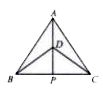
`DeltaABC and DeltaDBC` are two isosceles triangles on the same base BC and vertices A and D are on the same side of BC (see figure). If AD is extended to BP intersect BC at P, show that

`DeltaABP~=DeltaACP`

Promotional Banner

Topper's Solved these Questions

  • TRIANGLES

    MTG IIT JEE FOUNDATION|Exercise NCERT SECTION (Exercise 7.4)|6 Videos
  • TRIANGLES

    MTG IIT JEE FOUNDATION|Exercise NCERT SECTION (Exercise 7.5)|4 Videos
  • TRIANGLES

    MTG IIT JEE FOUNDATION|Exercise NCERT SECTION (Exercise 7.2)|9 Videos
  • STATISTICS

    MTG IIT JEE FOUNDATION|Exercise Olympiad/HOTS Corner |20 Videos

Similar Questions

Explore conceptually related problems

DeltaABC and DeltaDBC are two isosceles triangles on the same base BC and vertices A and D are on the same side of BC (see figure). If AD is extended to BP intersect BC at P, show that DeltaABD~=DeltaACD

DeltaABC and DeltaDBC are two isosceles triangles on the same base BC and vertices A and D are on the same side of BC (see figure). If AD is extended to intersect BC at P, show that : (i) DeltaABD cong DeltaACD (ii) DeltaABP cong DeltaACP (iii) AP bisects angleA as well as angleD (iv) AP is the perpendicular bisector of BC.

DeltaABC and DeltaDBC are two isosceles triangles on the same base BC and vertices A and D are on the same side of BC (see figure). If AD is extended to BP intersect BC at P, show that AP bisects angleA as well as angleD .

DeltaA B C and DeltaD B C are two isosceles triangles on the same base BC and vertices A and D are on the same side of BC (see Fig. 7.39). If AD is extended to intersect BC at P, show that (i) \ DeltaA B D~=DeltaA C D (ii) DeltaA B P~=DeltaACP (iii) AP bisects ∠ A as well as ∠ D (iv) AP is the perpendicular bisector of BC

Delta ABC and Delta DBC are two isosceles triangles on the same base BC and vertices A and D are on the same side of BC. If AD is extended to intersect BC at E show that

DeltaABC and DeltaDBC are two isosceles triangles on the same base BC and vertices A and D are on the same side of BC. If AD is extended to intersect BC at E, show that (i) DeltaABD ~=DeltaACD (ii) DeltaABE~=DeltaACE (iii) AE bisects angleA as well as angleD (iv) AE is the perpendicualr bisector of BC.

A B C\ a n d\ D B C are two isosceles triangles on the same bas B C and vertices A\ a n d\ D are on the same side of B C . If A D is extended to intersect B C at P , show that A B D\ ~= A C D (ii) A B P\ ~= A C P

△ABC and △DBC are two isosceles triangles on the same base BC and vertices A and D are on the same side of BC. If AD is extended to intersect BC at P, show that (i) △ABD≅△ACD (ii) △ABP≅△ACP (iii) AP bisects ∠A as well as △D . (iv) AP is the perpendicular bisector of BC.

A B C\ a n d\ D B C are two isosceles triangles on the same bas B C and vertices A\ a n d\ D are on the same side of B C . If A D is extended to intersect B C at P , show that A P bisects "\ "/_A as well as /_D A P is the perpendicular bisector of B C

ABC and DBC are two isosceles triangles on the same base BC (see Fig. 7.33). Show that /_A B D\ =/_A C D