Home
Class 9
MATHS
In a parallelogram ABCD, the sum of any ...

In a parallelogram ABCD, the sum of any two consecutive angles is `180 degree` and opposite angles are equal.
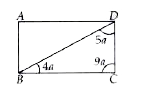
In the given figure, find `angleA` in the parallelogram .

A

`90^(@)`

B

`60^(@)`

C

`30^(@)`

D

`110^(@)`

Text Solution

Verified by Experts

The correct Answer is:

A
Promotional Banner

Topper's Solved these Questions

  • QUADRILATERALS

    MTG IIT JEE FOUNDATION|Exercise EXERCISE (Comprehension Type PASSAGE- III )|3 Videos
  • QUADRILATERALS

    MTG IIT JEE FOUNDATION|Exercise EXERCISE (Subjective Problems) (Very Short Answer Type)|10 Videos
  • QUADRILATERALS

    MTG IIT JEE FOUNDATION|Exercise EXERCISE (Comprehension Type PASSAGE-I)|3 Videos
  • PROBABILITY

    MTG IIT JEE FOUNDATION|Exercise OLYMPIAD/HOTS CORNER|20 Videos
  • STATISTICS

    MTG IIT JEE FOUNDATION|Exercise Olympiad/HOTS Corner |20 Videos

Similar Questions

Explore conceptually related problems

In a parallelogram ABCD, prove that sum of any two consecutive angles is 180^(@) .

In a parallelogram ABCD, prove that sum of any two consecutive angles is 180^(@).

In a parallelogram the sum of any two adjacent angles is 180^(@) .

In a parallelogram ABCD, the sum of any two consecutive angles is 180^(@) and opposite angles are equal. In a parallelogram ABCD, angleD=115^(@) , determine the measure of angleA and angleB

In a parallelogram,the bisectors of any two consecutive angles intersect at right angle.

In the given figure, ABCD and AEFD a re two parallelograms. PE =

In a parallelogram; the bisectors of any two consecutive angles intersect at right angle.

In a parallelogram ABCD ,determine the sum of angles /_C and /_D
