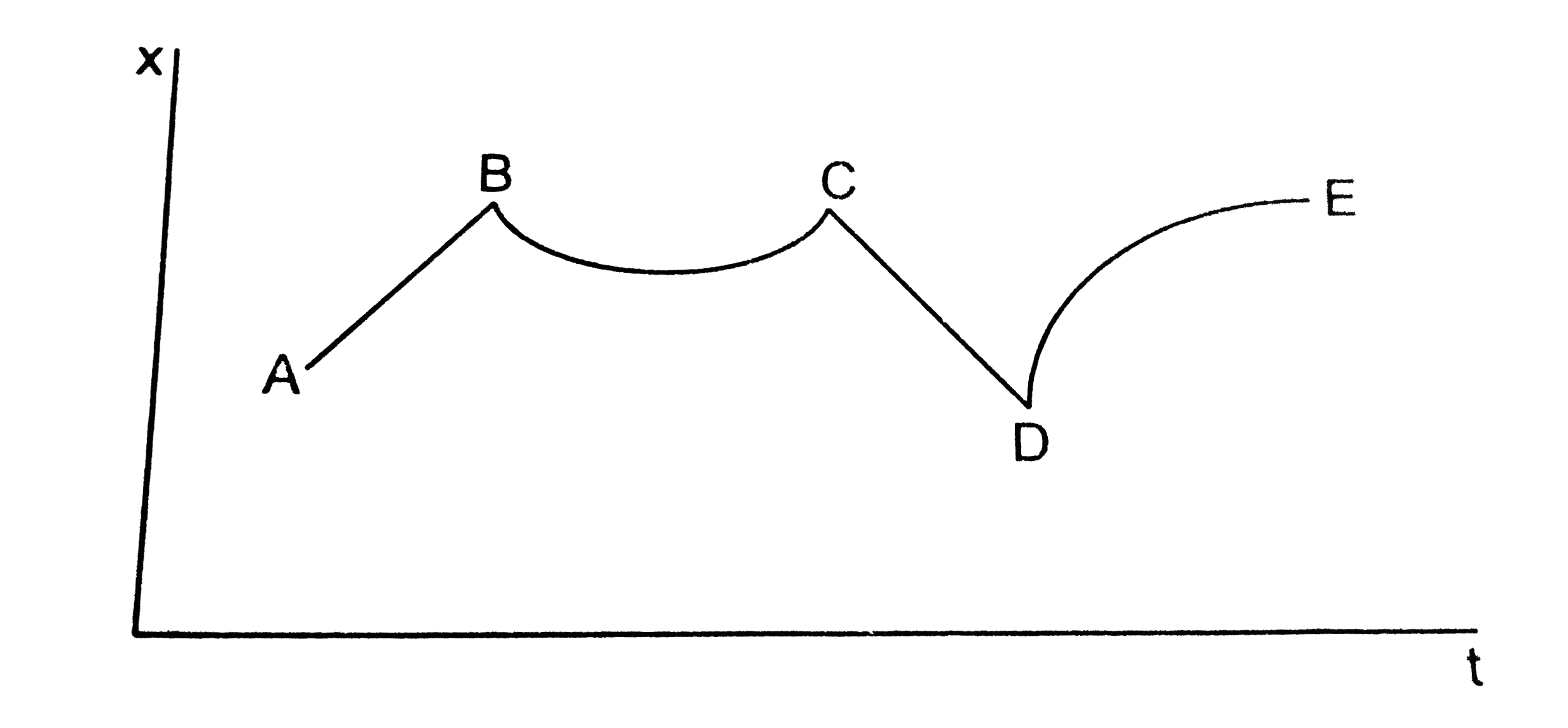
A
B
C
D
Text Solution
Verified by Experts
The correct Answer is:



Topper's Solved these Questions
Similar Questions
Explore conceptually related problems
MTG IIT JEE FOUNDATION-FOOTSTEPS TOWARDS JEE MAIN -Section B (Numerical Value Type Questions)
- Figure shows the displacement of a particle going along the X-axis as ...
Text Solution
|
- A body starts from rest at time t = 0 , the acceleration time graph ...
Text Solution
|
- A cricket ball of mass 500 g is moving with speed of 36 k m h^(-1) ...
Text Solution
|
- Two bodies with kinetic energies in the ratio 2 : 3 are moving with ...
Text Solution
|
- A hollow spherical object weighs 25 g in air. Its material density i...
Text Solution
|
- A boat at anchor is rocked by waves whose crests are 100 m apart and w...
Text Solution
|
- A car moving on a straight road covers 1/3 of the distance with 25 ...
Text Solution
|
- Sand drops from a stationary hopper at the rate of 5kg//s on to a conv...
Text Solution
|
- The acceleration due to gravity on the surface of a pulsar of mass M =...
Text Solution
|
- A body can reduce the pressure in his lungs to 750 mm of mercury. Us...
Text Solution
|
- A motor pump lifts 6 tonnes of water from a well of depth 25 m to the ...
Text Solution
|