Home
Class 9
PHYSICS
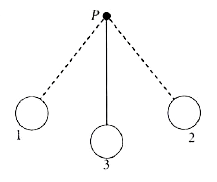
A mass hangs on a string fixed at point ...

A mass hangs on a string fixed at point P . It starts from position 1 and swings tot he farthest position on the opposite side, position 2. It then oscillates several times with decreasing amplitude before ending at position 3
Where does the ball have the maximum kinetic energy ?

A

At position 1

B

At position 2

C

The first time at position 3

D

The last time at position 3

Text Solution

Verified by Experts

The correct Answer is:

C

When the mass is at position 1, it has gravitational potential energy. After it swings and reaches position 3, its gravitational potential energy is transformed into kinetic energy . When it reaches position 3, its gravitational potential energy is transformed into kinetic energy. When it reaches position 2, its kinetic energy is transformed back into gravitational potential energy . When the mass continues to swing, some of its total energy is transformed into thermal energy and lost tot he surrounding. Hence the mass has the maximum kinetic energy at its first tie at position 3
Promotional Banner

Topper's Solved these Questions

  • FOOTSTEPS TOWARDS JEE MAIN

    MTG IIT JEE FOUNDATION|Exercise Section B (Numerical Value Type Questions)|10 Videos
  • FOOTSTEPS TOWARDS CBSE BOARD

    MTG IIT JEE FOUNDATION|Exercise Section - D |14 Videos

Similar Questions

Explore conceptually related problems

A bob of mass 2 kg hangs from a string of length 5 m . It swings from its rest position to one of the sides so that the string makes an angle of 60^(@) with the vertical Calculate the gain in potential energy of the bob .

If a body is executing simple harmonic motion and its current displacement is (sqrt(3))/(2) times the amplitude from its mean position, then the ratio between potential energy and kinetic energy is

If a body is executing simple harmonic motion and its current displacement is sqrt(3)//2 times the amplitude from its mean position , then the ratio between potential energy and kinetic energy is

Ratio of kinetic energy to potential energy of an oscillator when it is at distance 1//N times of amplitude from mean positions in

The hanging bob of a simple pendulum is displaced to one extreme position B and then released. It swings towards centre position A and then to the other extreme position C. In which position does the bob have : (i) maximum potential energy ? (ii) maximum kinetic energy ? Give reasons for your answer.

A uniform rod of mass m and length l is fixed from Point A , which is at a distance l//4 from one end as shown in the figure. The rod is free to rotate in a vertical plane. The rod is released from the horizontal position. What is the reaction at the hinge, when kinetic energy of the rod is maximum?

A ball of mass 2kg hanging from a spring oscillates with a time period 2pi seconds. Ball is removed when it is in equilibrium position, then spring shortens by

A ball of mass 5 kg hanging from a spring oscillates with a time period of 2 pi s . At any instant the ball is at equilibrium position, now the ball is removed, then spring shortens by

In the given figure, a mass M is attached to a horizontal spring which is fixed on one side to a rigid support. The spring constant of the spring is k. The mass oscillates on a frictionless surface with time period T and amplitude A. When the mass is in equilibrium position, as shown in the figure, another mass m is gently fixed upon it. The new amplitude of oscillation will be :

Two very small particles are executing SHM along very near parallel lines about the same mean position, same amplitude and the same frequency. At t = 0 both the particle are moving with speed of 1m//sec but on the opposite side of the mean position and having same direction of velocity at a distance of 5cm from the mean position. At t = 4sec they are at the same position moving with speed of 1m//sec but in opposite direction. Assuming that this is the minimum time form t = 0 where they are meeting for the 1st time. If the maximum speed of either particle is (xpi)/(4sqrt(2))cm//sec Find x
