

Home
Class 11
PHYSICS
A disk moving on a frictionless horizont...

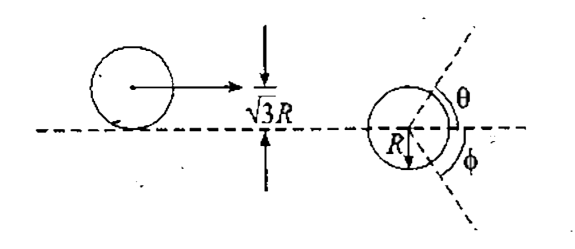
A disk moving on a frictionless horizontal table collides elastically y with another identical disk as shown. The directions of motion of the two disks make angles 0 and `phi` with the initial line of motion as shown. Then

Promotional Banner

Similar Questions

Explore conceptually related problems

A billiard ball collides elastically with an identical stationary ball. The collision is not head on. Show that the directions of motion of the two balls are at right angles after the collision. Solve the problem in centre of mass frame as well as in lab frame.

When is a collision said to be a perfectly inelastic? A mass is moving with speed v collides inelastically with another identical mass at rest. After collision, the first mass moves with velocity frac(nu)(sqrt 3) in a direction perpendicular to the initial direction of motion. Find the speed of the second mass after collision.

A sphere of mass m moves with a velocity 2v and collides inelastically with another identical sphere of mass m. After collision the first mass moves with velocity v in a direction perpendicular to the initial direction of motion . Find the speed of the second sphere after collision .

A mass ‘m’ moves with a velocity ‘v’ and collides inelastically with another identical mass at rest. After collision the 1st mass moves with velocity (v)/(sqrt(3)) in a direction perpendicular to the initial direction of motion. Find the speed of the 2^(nd) mass after collision :

A body (solid sphere) of mass m makes an elastic collision with another idential body at rest. Just after collision the angle between the velocity vector of one body with the initial line of motion is 15^(@) then the angle between velocity vector of the other body with the initial line of motion is