Home
Class 7
MATHS
(a) Can you now tell the order of the ro...

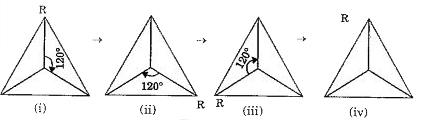
(a) Can you now tell the order of the rotational symmetry for an equilateral triangle ?

(b) How many position are there at which the triangle looks acactly the same when rotated about its centre by `120^(@)` ?

Text Solution

Verified by Experts

The correct Answer is:

`360^(@)`
Promotional Banner

Topper's Solved these Questions

  • SYMMETRY

    NAND LAL PUBLICATION|Exercise EXERCISE 14.1 |10 Videos
  • SYMMETRY

    NAND LAL PUBLICATION|Exercise EXERCISE 14.2|2 Videos
  • SIMPLE EQUATIONS

    NAND LAL PUBLICATION|Exercise SAMPLE PAPER FOR PRACTICE|23 Videos
  • THE TRIANGLE AND ITS PROPERTIES

    NAND LAL PUBLICATION|Exercise Sample Paper for Practice |9 Videos

Similar Questions

Explore conceptually related problems

Order of rotational symmetry in an equilateral triangle is ............

How can you say that the figure possesses rotational symmetry of order 4.

After rotating by 60° about a centre, a figure looks exactly the same as its original position. At what other angles will this happen for the figure

A small sphere rolls down without slipping from the top of a track in a vertical plane. The track has an elevated section and a horizontal part is 1.0 m above the ground level and the top of the track is 2.4 m above the ground. Find the distance on the ground with respect to the point B (which is vertically ) below the end of the track as shown in figure. Where the sphere lands. During its flight as a projectile does the sphere continue to rotate about its centre of mass? Explain.

The sum of the legs of a right triangle is 9 cm. When the triangle rotates about one of the legs, a cone result which has the maximum volume. Then

A small retangular coil ABCD contains 140 turns of wire. The sides AB and BC of the coil are of length 4.5 and 2.8 cm respectively, as shown in the figure The coil is held between the poles of a large magnet so that the coil can rotate about an axis thorugh its centre. The magnet produces a uniform magnetic field of flux density B between its poles. When the current in the coil is 170 mA, the maximum torque produced in the coil is 2.1 xx 10^-3 N m . For the coil in the position shown in the figure. calculate the magnitude of the force on (i) side AB of the coil and (ii) side BC of the coil.

A small retangular coil ABCD contains 140 turns of wire. The sides AB and BC of the coil are of length 4.5 and 2.8 cm respectively, as shown in the figure The coil is held between the poles of a large magnet so that the coil can rotate about an axis thorugh its centre. The magnet produces a uniform magnetic field of flux density B between its poles. When the current in the coil is 170 mA, the maximum torque produced in the coil is 2.1 xx 10^-3 N m . For the coil in the position for maximum torque, state whether the plane of the coil is parallel to, or normal to , the direction of the magnetic field.

A small retangular coil ABCD contains 140 turns of wire. The sides AB and BC of the coil are of length 4.5 and 2.8 cm respectively, as shown in the figure The coil is held between the poles of a large magnet so that the coil can rotate about an axis thorugh its centre. The magnet produces a uniform magnetic field of flux density B between its poles. When the current in the coil is 170 mA, the maximum torque produced in the coil is 2.1 xx 10^-3 N m . Use your answer to show that the magnetic flux density B between the poles of the magnet is 70 mT.

A small retangular coil ABCD contains 140 turns of wire. The sides AB and BC of the coil are of length 4.5 and 2.8 cm respectively, as shown in the figure The coil is held between the poles of a large magnet so that the coil can rotate about an axis thorugh its centre. The magnet produces a uniform magnetic field of flux density B between its poles. When the current in the coil is 170 mA, the maximum torque produced in the coil is 2.1 xx 10^-3 N m . The current in the coil in (a) is switched off and the coil s positioned as shown in the figure. The coil is then turned thorugh an angle of 90^@ in a time of 0.14 s. Calculate the average e.m.f. induced in the coil.
