Home
Class 10
CHEMISTRY
Did doberiner's triads also exist in the...

Did doberiner's triads also exist in the columns of newlands's octaves? Compare and find out.

Text Solution

Verified by Experts
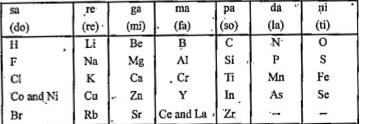
Newlands. Octaves are given below:

It is clear from this. table that Dobereiner.s triads like Li, Na, K also exist in the columns of Newlands. octaves.
Promotional Banner

Topper's Solved these Questions

  • PERIODIC CLASSIFICATION OF ELEMENTS

    SWAN PUBLICATION|Exercise Textbook Questions |13 Videos
  • PERIODIC CLASSIFICATION OF ELEMENTS

    SWAN PUBLICATION|Exercise TEXTBOOK EXERCISES|19 Videos
  • METALS AND NON METALS

    SWAN PUBLICATION|Exercise ADDITIONAL IMPORTANT QUESTIONS ( Long Answer Type Questions )|9 Videos

Similar Questions

Explore conceptually related problems

On comparing the ratios (a_1)/(a_2), (b_1)/b_2 and (c_1)/(c_2) find out whether the lines representing the following pairs of linear equations are consistent , or inconsistent . : 3/2x+5/3y=7,9x-10y=14 .

On comparing the ratios (a_1)/(a_2), (b_1)/b_2 and (c_1)/(c_2) find out whether the lines representing the following pairs of linear equations are consistent , or inconsistent . : 5x-3y=11, -10x+6y=-22.

On comparing the ratios (a_1)/(a_2), (b_1)/b_2 and (c_1)/(c_2) find out whether the lines representing the following pairs of linear equations are consistent , or inconsistent . : 2x-3y=8, 4x-6y=9 .

On comparing the ratios (a_1)/(a_2), (b_1)/b_2 and (c_1)/(c_2) find out whether the lines representing the following pairs of linear equations are consistent , or inconsistent . : 3x+2y=5, 2x-3y=7 .

On comparing the ratios (a_1)/(a_2), (b_1)/b_2 and (c_1)/(c_2) find out whether the lines representing the following pairs of linear equations are consistent , or inconsistent . : 4/3x+2y=8,2x+3y=12.

On comparing the ratios (a_1)/(a_2), (b_1)/(b_2), (c_1)/(c_2) and without drawing them, find out whether the lines representing the following pairs of linear equations intersect at a point, are parallel or coincide. Also, find out whether the following pair of linear equations are consistent or inconsistent : 3x-4y=1 8y-6x=4 .

On comparing the ratios (a_1)/(a_2), (b_1)/(b_2), (c_1)/(c_2) and without drawing them, find out whether the lines representing the following pairs of linear equations intersect at a point, are parallel or coincide. Also, find out whether the following pair of linear equations are consistent or inconsistent : 2y-x=3 2x+3y=1 .

On comparing the ratios (a_1)/(a_2), (b_1)/(b_2), (c_1)/(c_2) and without drawing them, find out whether the lines representing the following pairs of linear equations intersect at a point, are parallel or coincide. Also, find out whether the following pair of linear equations are consistent or inconsistent : 3x-4y=-7 3x-4y=-9 .

On comparing the ratios (a_1)/(a_2), (b_1)/(b_2), (c_1)/(c_2) and without drawing them, find out whether the lines representing the following pairs of linear equations intersect at a point, are parallel or coincide. Also, find out whether the following pair of linear equations are consistent or inconsistent : 6x-21y+12=0 10x-35y+20 = 0 .

On comparing the ratios (a_1)/(a_2), (b_1)/(b_2), (c_1)/(c_2) and without drawing them, find out whether the lines representing the following pairs of linear equations intersect at a point, are parallel or coincide. Also, find out whether the following pair of linear equations are consistent or inconsistent : 3x-y-7=0 9x-3y+25=0 .

