Home
Class 11
CHEMISTRY
The fraction of gaseous molecules having...

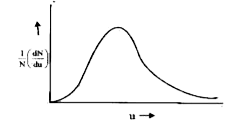
The fraction of gaseous molecules having speed in between u and u+ du as governed by Maxwell distribution of speeds is given by `(dN_(u))/(N) = 4pi ((M)/(2pi RT))^(1//2)` exp `(-"Mu"^(2)//2 RT) u^(2)` du
Graphically this distribution is shown in fig.

Based on this distribution, answer the following three question
With increase in temperature, the quantity (dN/N)/du in the high speed range

A

increases

B

decreases

C

shows no change

D

increases or decreases depending upon the gas

Text Solution

Verified by Experts

The correct Answer is:

A

In the high speed range , the reverse of the effects discussed in (i) is observed , consequently the fraction increases.
Promotional Banner

Topper's Solved these Questions

  • STATES OF MATTER

    BRILLIANT PUBLICATION|Exercise LEVEL III (Statement Type )|5 Videos
  • SOME BASIC CONCEPTS OF CHEMISTRY

    BRILLIANT PUBLICATION|Exercise LEVEL-I|55 Videos
  • STRUCTURE OF ATOMS

    BRILLIANT PUBLICATION|Exercise LEVEL - III (Linked Comprehension Type)|8 Videos

Similar Questions

Explore conceptually related problems

The fraction of gaseous molecules having speed in between u and u+ du as governed by Maxwell distribution of speeds is given by (dN_(u))/(N) = 4pi ((M)/(2pi RT))^(1//2) exp (-"Mu"^(2)//2 RT) u^(2) du Graphically this distribution is shown in fig. Based on this distribution, answer the following three question With increase in temperature, the quantity (dN/N)/du in the low speed range.

The fraction of gaseous molecules having speed in between u and u+ du as governed by Maxwell distribution of speeds is given by (dN_(u))/(N) = 4pi ((M)/(2pi RT))^(1//2) exp (-"Mu"^(2)//2 RT) u^(2) du Graphically this distribution is shown in fig. Based on this distribution, answer the following three question The maximum value of (dN/N)/du corresponds to most probable speed. With increase in temperature, this maximum fraction

Maxwell and Boltzmann have shown that actual distribution of molecular speeds depends on temperature and molecular mass. At the same temperature which will move faster, N_2 or Cl_2 ?

For one-electron species, the wave number of radiation emitted during the transition of electron from a higher energy state (n_(2)) to a lower energy state (n_(1)) is given by: bar v =(1)/(lamda)=R_(H) xx Z^() ((1)/(n_(1)^(2)) (1)/(n_(2)^(2))) where R_(H)=(2 pi m_(s) k^(2) c^(4))/(h^(3) c) is Rydberg constant for hydrogen atom. Now, considering nuclear motion, the accurate measurement would be obtained by replacing mass of electron (m_(e)) by the reduced mass (mu) in the above expression, defined as mu =(m_(n)xx m_(e))/(m_(n) +m_(e)) where m_(n) = mass of nucleus. For Lyman series, n_(t) =1 (fixed for all the lines) while n_(2) = 2, 3, 4 .... For Balmer series: n_(1) = 2 (fixed for all the lines) while n_(2) = 3,4,5 .... If proton in hydrogen nucleus is replaced by a positron having the same mass as that of an electron but same charge as that of proton, then considering the nuclear motion, the wavenumber of the lowest energy transition of He+ ion in Lyman series will be equal to
