Home
Class 11
CHEMISTRY
The fraction of gaseous molecules having...

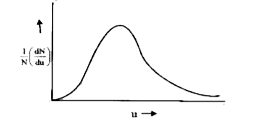
The fraction of gaseous molecules having speed in between u and u+ du as governed by Maxwell distribution of speeds is given by `(dN_(u))/(N) = 4pi ((M)/(2pi RT))^(1//2)` exp `(-"Mu"^(2)//2 RT) u^(2)` du
Graphically this distribution is shown in fig.

Based on this distribution, answer the following three question
The maximum value of (dN/N)/du corresponds to most probable speed. With increase in temperature, this maximum fraction

A

increases

B

decreases

C

shows no change

D

increases or decreases depending upon the gas

Text Solution

Verified by Experts

The correct Answer is:

B

Here , also fraction decreases .
Promotional Banner

Topper's Solved these Questions

  • STATES OF MATTER

    BRILLIANT PUBLICATION|Exercise LEVEL III (Statement Type )|5 Videos
  • SOME BASIC CONCEPTS OF CHEMISTRY

    BRILLIANT PUBLICATION|Exercise LEVEL-I|55 Videos
  • STRUCTURE OF ATOMS

    BRILLIANT PUBLICATION|Exercise LEVEL - III (Linked Comprehension Type)|8 Videos

Similar Questions

Explore conceptually related problems

The fraction of gaseous molecules having speed in between u and u+ du as governed by Maxwell distribution of speeds is given by (dN_(u))/(N) = 4pi ((M)/(2pi RT))^(1//2) exp (-"Mu"^(2)//2 RT) u^(2) du Graphically this distribution is shown in fig. Based on this distribution, answer the following three question With increase in temperature, the quantity (dN/N)/du in the low speed range.

The fraction of gaseous molecules having speed in between u and u+ du as governed by Maxwell distribution of speeds is given by (dN_(u))/(N) = 4pi ((M)/(2pi RT))^(1//2) exp (-"Mu"^(2)//2 RT) u^(2) du Graphically this distribution is shown in fig. Based on this distribution, answer the following three question With increase in temperature, the quantity (dN/N)/du in the high speed range

Which of the following molecules will have the higher value of most probable speed at the same temperature , N_2 or Cl_2 ? Justify.

Draw the Maxwell- Boltzmann distribution showing all the molecular speeds.

The probability distribution of a random variable X is given in the following table: Find the probability that X lies between 1 and 4.
