Home
Class 12
CHEMISTRY
This energy lies in visible region and i...


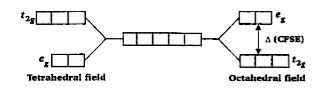
This energy lies in visible region and ie, why electronic transition `t_(2g) hArr e_(g)` are responsible for colour. Such transitions are not possible `d^0 and d^10` configuration.
`Ti_((aq.))^(3+)` is purple while`Ti_((aq.))^(4+)` is colourless because :

A

There is no crystal field effect in `Ti_(4+)`

B

The energy difference between `t_(2g) and e_(g)` of `Ti^(4+)` is quite high and does not fall in the visible region.

C

`Ti^(4+) " had " d^0` configuration

D

`Ti^(4+)` is very small in comparison to `Ti^(3+)` and hence does not absorb any radiation.

Text Solution

Verified by Experts

The correct Answer is:

C

Due to `d^0` configration of `Ti^(4+)` d- d transition is not possible.
Promotional Banner

Topper's Solved these Questions

  • COORDINATION COMPOUNDS

    BRILLIANT PUBLICATION|Exercise LEVEL III (Linked Comprehension Type) (Paragraph III)|3 Videos
  • COORDINATION COMPOUNDS

    BRILLIANT PUBLICATION|Exercise LEVEL III (Linked Comprehension Type) (Paragraph IV)|3 Videos
  • COORDINATION COMPOUNDS

    BRILLIANT PUBLICATION|Exercise LEVEL III (Linked Comprehension Type) (Paragraph- I)|3 Videos
  • CO-ORDINATION COMPOUNDS AND ORGANOMETALLICS

    BRILLIANT PUBLICATION|Exercise Level-II (Assertion- Reason)|4 Videos
  • D & F BLOCK ELEMENTS

    BRILLIANT PUBLICATION|Exercise Level -II|38 Videos

Similar Questions

Explore conceptually related problems

transition elements are 'd' block elements. Cr^(2+) and Mn^(3+) have d^4 configuration. But Cr^(2+) is reducing and Mn^(3+) is oxidizing. Why?

Assertion : [Ti(H_2O)_6]^(3+) is coloured while [Sc(H_2O)_6]^(3+) is colourless. Reason : d-d transition is not possible in [Sc(H_2O)_6]^(3+)

Two compounds of iron are given. FeSo_4, Fe_2(SO_4)_3 (The oxidation state of SO_4 -2 ) a. Identify the compound in which iron shows +2 oxidation state. b. Which of these compound posses Fe^3+ ions. c. write the subshell electronic configuration of Fe^3+ ions d. Give reason for the various oxidation states of transition elements.

Fuel cells are galvanic cells in which the chemical energy of fuel is directly converted into electrical energy. Type of fuel cell is a hydrogen - oxygen fuel cell. It consists of two electrodes made up of two porous graphite impregnated with a catalyst (platinum, silver, or metal oxide). The electrodes are placed in aqueous solution of NaOH. Oxygen and hydrogen are continuously fed into the cell. Hydrogen gets oxidized to H^(oplus) which is neutralized by overset(Θ)(OH) , ie., anodic reaction. H_(2) hArr 2H^(oplus) + 2e^(-) 2H^(oplus) + 2 overset(Θ)(OH) hArr 2H_(2)O H_(2) + 2 overset(Θ)(OH) hArr 2H_(2)O + 2e^(-) At cathode, O_(2) gets reduced to overset(Θ)(OH) i.e., O_(2) + 2H_(2)O + 4e^(-) hArr overset(Θ)(4)OH Hence, the net reaction is 2H_(2) + O_(2) hArr 2H_(2)O The overall reaction has Delta H= -285.6kJ mol^(-1) and Delta G= -237.4kJ mol^(-1) " at " 25^(@)C If the cell voltage is 1.23V for the H_(2)-O_(2) fuel cell and for the half cell: O_(2) + 2H_(2) O + 4e^(-) hArr 4 overset(Θ)(OH) " has " E^(Θ) = 0.40V , then E^(Θ) " for " 2H_(2)O + 2e^(-) hArr H_(2) + 2 overset(Θ)(OH) will be
