Home
Class 12
PHYSICS
Statement I : A small unchanged solid co...

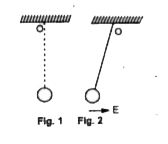
Statement I : A small unchanged solid conducting sphere is supended from a fixed point O by a light insulating string (figure 1). The system is in equilibrium. Now a horizontal unifrom electric field E is switched on As a result the conducting sphere is deflected towards left as shown (figurte 2)

Statement II : When a solid conducting sphere having zero net charge is placed in uniform electric field, charges are inducned on the surface of sphere.

A

Statement I is True, Statement II is True, Statement II is a correct explantion for Statement I

B

Statement I is True, Statement II is True, Statement II is not a correct explanation for Statement I

C

Statement I is True, Statement II is False.

D

Statement I is False, Statement II is True.

Text Solution

Verified by Experts

The correct Answer is:

D

Charge is induced on surface of conducting sphere when electric field is switched on, but net charge on conducting sphere remains zero. Electric force on a charged body placed in uniform electric fields is the product of charge and electric field. Hence exerted by electric field on conducing sphere is zero Therefore statement 1 is false.
Promotional Banner

Similar Questions

Explore conceptually related problems

Electric field inside a conducting sphere is

An electric dipole is placed in a uniform electric field of Intensity E as shown in the figure. What is the net force on the system?

A hollowing insulated conducting sphere is given a positive charge of 10mu what will be the electric field at the center of the sphere if its radius is 2 meters?

A metal sphere of radius R carrying q (+ve) charges is shown in the figure. br Derive the strength of electric field at a distance r from the centre of sphere.

A spherical charged conductor has sigma as the surface charge density. The electricfield on its surface is E. The radius of the sphere is doubled keeping the surface charge density unchanged. Then the electric field on the surface of the new sphere is,
