Home
Class 14
MATHS
In the figure, number in any cell is obt...

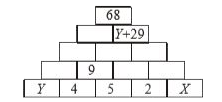
In the figure, number in any cell is obtained by adding two numbers in the cells directly below it. For example, 9 in the second row is obtained by adding the two numbers 4 and 5 directly below it. The value of X - Y is

A

2

B

4

C

3

D

5

Text Solution

Verified by Experts

The correct Answer is:

B
Promotional Banner

Topper's Solved these Questions

  • NUMBER SYSTEM

    DISHA PUBLICATION|Exercise Expert Level |32 Videos
  • NUMBER SYSTEM

    DISHA PUBLICATION|Exercise Test Yourself|15 Videos
  • NUMBER SYSTEM

    DISHA PUBLICATION|Exercise Practice Exercise (Foundation Level)|65 Videos
  • MOCK TEST 2

    DISHA PUBLICATION|Exercise Multiple Choice Questions|20 Videos
  • PERCENTAGES

    DISHA PUBLICATION|Exercise PRACTICE EXERCISE (TEST YOURSELF)|15 Videos

Similar Questions

Explore conceptually related problems

Number of cells obtained by meiosis :–

If three numbers are in G.P., then the numbers obtained by adding the middle number to each of these numbers are in

5 added to a number gives 9. Find the number.

In each of the following questions, two rows of numbers are given. The resultant number in each row is to be worked out separately based on the following rules and the questions below the rows of numbers are to be answered. The operations of numbers progress from the left to the right. Rules: (i) if an odd number is followed by a two-digit even number then they are to be added. (ii) If an odd number is followed by a two-digit odd number then the second number is to be subtracted from the first number. (iii) If an even number is followed by a number which is the perfect square of a number then the second number is to be divided by the first number. (iv) If an even number is followed by a two-digit even number then the first number is to be multiplied by the second number. 19 15 12 15 12 23 16 If the resultant of the second set of numbers is subtracted from the resultant of the first set of numbers, what will be the outcome ? 1) 44 2) 92 3) 29 4) 43 5) None of these

In each of the following questions, two rows of numbers are given. The resultant number in each row is to be worked out separately based on the following rules and the questions below the rows of numbers are to be answered. The operations of numbers progress from the left to the right. Rules: (i) if an odd number is followed by a two-digit even number then they are to be added. (ii) If an odd number is followed by a two-digit odd number then the second number is to be subtracted from the first number. (iii) If an even number is followed by a number which is the perfect square of a number then the second number is to be divided by the first number. (iv) If an even number is followed by a two-digit even number then the first number is to be multiplied by the second number. 8 16 16 14 13 11 12 144 What is the difference between the resultant of the set of numbers and the second set of numbers ? 1) 222 2) 210 3) 118 4) 106 5) None of these

In each of the following questions, two rows of numbers are given. The resultant number in each row is to be worked out separately based on the following rules and the questions below the rows of numbers are to be answered. The operations of numbers progress from the left to the right. Rules: (i) if an odd number is followed by a two-digit even number then they are to be added. (ii) If an odd number is followed by a two-digit odd number then the second number is to be subtracted from the first number. (iii) If an even number is followed by a number which is the perfect square of a number then the second number is to be divided by the first number. (iv) If an even number is followed by a two-digit even number then the first number is to be multiplied by the second number. 40 30 3600 15 24 17 What is the sum of the two resultant numbers of the set of numbers given above ? 1) 22 2) 25 3) 28 4) 42 5) None of these

A two digit number is obtained by either multiplying sum of digits by 8 and adding 1 or by multiplying the difference of the digits by 13 and adding 2. Find the number.

In each of the following questions two rows of numbers are given. The resultant number in each row is to be worked out separately based on the following rules and the questions below the rows of numbers are to be answered. The operations of numbers progress from left to right. Rules. (i) If a two-digit odd number is followed by a two-digit odd number they are to be added. (ii) If a two-digit even number is followed by a two - digit odd number which is a perfect square, the even number is to be subtracted from the odd number. (iii) If a three-digit number is followed by a two-digit number the first number is to be divided by the second number. (iv) If a prime number is followed by an even number the both two are to be added. (v) If an even number is followed by another even number the both two are to be multiplied. {:(23,15,12),(X,24,49):} If X is the resultant of the first row, what is the resultant of the second row ?

DISHA PUBLICATION-NUMBER SYSTEM-Standard Level
  1. Find the HCF of (3^(125)-1)and(3^(35)-1).

    Text Solution

    |

  2. A computer program was tested 300 times before its release. The testin...

    Text Solution

    |

  3. In the figure, number in any cell is obtained by adding two numbers in...

    Text Solution

    |

  4. A natural number when increased by 50% has its number of factors uncha...

    Text Solution

    |

  5. Let x denote the greatest 4-digit number which when divided by 6, 7, 8...

    Text Solution

    |

  6. (x-1)(x-2)(x-3)=6y How many integer solutions exist for the given eq...

    Text Solution

    |

  7. A is the set of the first 100 natural numbers. What is the minimum num...

    Text Solution

    |

  8. The power of 45 that will exactly divides 123! Is

    Text Solution

    |

  9. What is the remainder when 32^(32^(32)) is divided by 7 ?

    Text Solution

    |

  10. Two different two-digit natural numbers are written beside each other ...

    Text Solution

    |

  11. In a three-digit number, the unit digit is twice the tens digit and th...

    Text Solution

    |

  12. If (45)/(53)= frac(1)(a+frac(1)(b+frac(1)(c-frac(2)(5)))) Where a,b an...

    Text Solution

    |

  13. If m and n are positive integers such that (m-n)^(2)=(4mn)/((m+n-1)), ...

    Text Solution

    |

  14. Simplification:- 5 * ? = 8042/4

    Text Solution

    |

  15. The number of zeros at end of the product of 222^(111) xx 35^(53) + ...

    Text Solution

    |

  16. The highest power of 17 which can divide exactly the following express...

    Text Solution

    |

  17. Find the remainder when 2^(2) + 22^(2) + 222^(2) + …… + (222…… 49 time...

    Text Solution

    |

  18. Find the last non-zero digit of 96!.

    Text Solution

    |

  19. When 96 is added to a N^(2), it gives another perfect square. If N is ...

    Text Solution

    |

  20. The numbers 1 to 29 are written side by side as follows 1234567891011…...

    Text Solution

    |
