Home
Class 12
PHYSICS
In the figure area of each plate is A an...

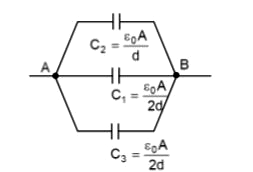
In the figure area of each plate is A and the distance between consecutive plates is as shown in the figure. What is the effective capacitance between points A & B.

(a) `(Aepsilon_(0))/(d)`
(b) `(3A epsilon_(0))/(d)`
(c) `(2A epsilon_(0))/(d)`
(d) `(4 A epsilon_(0))/(d)`

A

`(A epsi_0)/(d)`

B

`(3A epsi_0)/(d)`

C

`(2A epsi_0)/(d)`

D

`(4A epsi_0)/(d)`

Text Solution

Verified by Experts

The correct Answer is:
C


`C_(eq) = (epsi_0 A)/(d) + (epsi_0 A)/(2d) + (epsi_0 A)/(2d) = (2 epsi_0 A)/(d)`
Promotional Banner

Similar Questions

Explore conceptually related problems

The area of every plate shown in the figure is A and the separation between the successive plates is d. What is the capacitance between points a and b ? (a) (epsilon_(0)A)/(d) (b) (2epsilon_(0)A)/(d) (c) (3epsilon_(0)A)/(d) (d) (4epsilon_(0)A)/(d)

What is the distance between A (4,0) and B (8, 0).

Two charges are at a distance d apart. If a copper plate of thickness d/2 is placed between them, if effective force will be,

What is the area of the plates of a 2 F parallel plate capacitor given that the separation between the plates is 0.5 cm ?

Draw schematic diagram of Young experiment and drive B=(lamda D)/d for the distance between two consecutive bright interference fringes.

Identify the following figure with A,B,C and D

Write the coordinates of the points marked on the axes in the given figure : The coordinates of D are (0, -4) . Why ?

A charged metallic sphere A is suspended by a nylon thread. Another charged metallic sphere B held by an insulating handle is brought close to A such that the distance between their centres is 10 cm, as shown in figure (a). The resulting repulsion of A is noted (for example, by shining a beam of light and measuring the deflection of its shadow on a screen). Spheres A and B are touched by uncharged spheres C and D respectively, as shown in figure (b). C and D are then removed and B is brought closer to A to a distance of 5.0 cm between their centres, as shown in figure (c). What is the expected repulsion of A on the basis of Coulomb's law ? Spheres A and C and spheres B and D have identical sizes. Ignore the sizes of A and B in comparison to the separation between their centres.

If the roots of x^2-b x+c=0 are two consecutive integers, then b^2-4c is 0 (b) 1 (c) 2 (d) none of these

