Home
Class 12
CHEMISTRY
Discuss the effect of catalyst on the ac...

Discuss the effect of catalyst on the activation energy.

Text Solution

Verified by Experts
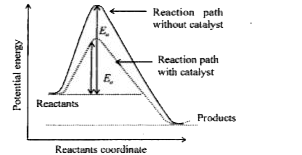
Catalyst lowers the activation energy. It provides an alternate path for the reaction. Catalyst increases the rate of reaction by lowering the activation energy. Lower the activation energy, faster will be the rate of reaction. It can be shown diagrammatically as :
Promotional Banner

Topper's Solved these Questions

  • CHEMICAL KINETICS

    OMEGA PUBLICATION|Exercise MULTIPLE CHOICE QUESTIONS (MCQ s)|36 Videos
  • BIOMOLECULES

    OMEGA PUBLICATION|Exercise MULTIPLE CHOICE QUESTIONS |74 Videos
  • CHEMISTRY IN EVERYDAY LIFE

    OMEGA PUBLICATION|Exercise MULTIPLE CHOICE QUESTIONS (MCQs)|20 Videos

Similar Questions

Explore conceptually related problems

Arrhenius studies the effect of temperature on the rate of a reaction and postulated that rate constant varies with temperature exponentially as k=Ae^(-E_(a)//RT) . This method is generally used for finding the activation energy of a reaction. Keeping temperature constant, the effect of catalyst on the activation energy has also been studied. If x is the fraction of molecules having energy greater than E_(a) it will be given by : a) x=-(E_(a))/(RT) b) In x=-(E_(a))/(RT) c) x=e^(E_(a)//RT) d) Any of these

Arrhenius studies the effect of temperature on the rate of a reaction and postulted that rate constant varies with temperature exponentially as k=Ae^(E_(a)//RT) . Thuis method is generally used for finding the activation energy of a reaction. Keeping temperature constant, the effect of catalyst on the activation energy has also been studied. The pre-exponetial factor in the Arrhenius equation of a first order reaction has the unit : a) mol L^(-1)s^(-1) b) L mol^(1)s^(-1) c) s^(-1) d) dimensionless

Arrhenius studies the effect of temperature on the rate of a reaction and postulted that rate constant varies with temperature exponentially as k=Ae^(E_(a)//RT) . Thuis method is generally used for finding the activation energy of a reaction. Keeping temperature constant, the effect of catalyst on the activation energy has also been studied. If the rate of reaction doubles for 10^(@)C rise of temperature form 290K to 300K, the activation energy of the reaction will be approximately: a) 40 Kcal mol^(-1) b) 12 Kcal mol^(-1) c) 60 Kcal mol^(-1) d) 70 Kcal mol^(-1)

At 27^@C in the presence of a catalyst, the activation energy of a reaction is lowered by 10 kJ mol^-1 . The ratio of log k (catalyst)/k (uncatalysed) is

Discuss the effects of light on plants

Discuss the effect of light on animals.

The activation energy of a first order reaction at 300 K is 60 kJ mol^-1 . In the Presence of a Catalyst, the activation energy gets lowered to 50 kJ mol^-1 at 300 K. How many times the reaction rate changes in the Presence of a catalyst at the same temperature ?

OMEGA PUBLICATION-CHEMICAL KINETICS -MULTIPLE CHOICE QUESTIONS (MCQ s)
  1. Discuss the effect of catalyst on the activation energy.

    Text Solution

    |

  2. Consider the chemical reaction, N (2) (g) + 3 H (2)(g) to 2 NH (3) (...

    Text Solution

    |

  3. For a reaction involving solid, decreasing which given below will incr...

    Text Solution

    |

  4. Rate of first order reaction depends upon

    Text Solution

    |

  5. Under a given set of experimental conditions, with increase of concent...

    Text Solution

    |

  6. Rate at which a substance reacts depends upon its

    Text Solution

    |

  7. RCOO R ' + Na OH to RCOO Na + R ' OH. What type of reaction is this ?

    Text Solution

    |

  8. Units of rate constant for the first and zero order reactions in terms...

    Text Solution

    |

  9. Units of specific reaction rate for 2nd order reaction is

    Text Solution

    |

  10. The units of rate constant for first order equation.

    Text Solution

    |

  11. The hydrolysis of ester in alkaline medium is a

    Text Solution

    |

  12. Given the unit of second order rate constant

    Text Solution

    |

  13. The half life period of a zero order reaction is independent of initia...

    Text Solution

    |

  14. What is the effect of temperature on rate of a reaction.

    Text Solution

    |

  15. The activation energy of reaction is equal to

    Text Solution

    |

  16. The activation energy of a reaction can be determined by

    Text Solution

    |

  17. The wavelength of first spectral line in the balmer series is 6561 ang...

    Text Solution

    |

  18. The substance that increases the speed of a chemical reactions is call...

    Text Solution

    |

  19. The reaction rate is found to depend upon two concentration terms. The...

    Text Solution

    |

  20. For which of the following , the units of r constant and rate of the r...

    Text Solution

    |

  21. A zero order reaction is one whose rate independent of

    Text Solution

    |

