Home
Class 11
PHYSICS
A spring having with a spring constant 1...

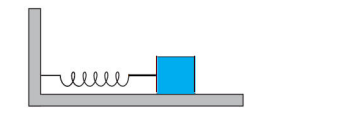
A spring having with a spring constant` 1200 N m^-1` is mounted on a horizontal table as shown in Fig. 14.24. A mass of 3 kg is attached to the free end of the spring. The mass is then pulled sideways to a distance of 2.0 cm and released.Determine maximum acceleration of the mass,

Text Solution

Verified by Experts

We are given : `k=1200" N/m",m=3kg`
`A=2" cm"=2xx10^(-2)m`
Maximum acceleration
`a_("max")=omega^(2)A=2xx10^(-2)xx(20)^(2)=8"m/s"^(2)`.
Promotional Banner

Similar Questions

Explore conceptually related problems

A spring having with a spring constant 1200 N m^-1 is mounted on a horizontal table as shown in Fig. 14.24. A mass of 3 kg is attached to the free end of the spring. The mass is then pulled sideways to a distance of 2.0 cm and released.Determine the maximum speed of the mass

A spring having with a spring constant 1200 N m^-1 is mounted on a horizontal table as shown in Fig. 14.24. A mass of 3 kg is attached to the free end of the spring. The mass is then pulled sideways to a distance of 2.0 cm and released.Determine the frequency of oscillations,

A steel wire of mass mu per unit length with a circular cross section has a radius of 0.1 cm. The wire is of length 10 m when measured lying horizontal, and hangs from a hook on the wall. A mass of 25 kg is hung from the free end of the wire. Assuming the wire to be uniform and lateral strains < < longitudinal strains, find the extension in the length of the wire. The density of steel is 7860 kg m^-3 (Young's modulues Y = 2 xx 10^11 N m^-2)

Two bodies of masses 1 kg and 3 kg respectively are connected rigidly by a vertical spring. The body of mass 3 kg rests on a smooth horizontal surface. The force constant of the spring is 484Nm^(-1) . From the equilibrium position, the mass of 1 kg is displaced vertically through a distance of 0.02 m and then released. calculate (i) and frequency of oscillation of the mass of 1 kg (ii) the maximum velocity of this mass (iii) its oscillation energy and (iv) the reaction of the table on the mass of 3 kg, when mass 1 kg is having harmonic oscillations.

When a mass is attached to a spring, its length is increased by 20 cm. It is now further lowered and releases. The time period is

A pair of parallel horizontal conducting rails of negligible resistance shorted at one end is fixed on a table. The distance between the rails is L. A conducting massless rod of resistance R can slide on the rails frictionlessly. The rod is tied to a massless string which passes over a pulley fixed to the edge of the table, A mass m, tied to the other end of the string hanges vertically. A constant magnetic field B exists perpendicular to the table. If the system is released from rest, calculate. the acceleration of the mass at the instant when the velocity of the rod is half the terminal velocity.

A long straight wire carrying current of 25 A rests on a table as shown in Fig. EP 4.22. Another wire PQ of length 1m, mass 2.5 g carries the same current but in the opposite direction. The wire PQ is free to slide up and down. To what height will PQ rise?

Figure 14.26 (a) shows a spring of force constant k clamped rigidly at one end and a mass m attached to its free end. A force F applied at the free end stretches the spring. Figure 14.26 (b) shows the same spring with both endsfree and attached to a mass m at either end. Each end of the spring in Fig. 14.26(b) is stretched by the same force F If the mass in Fig. (a) and the two masses in Fig. (b) are released, what is the period of oscillation in each case ?
