Home
Class 12
PHYSICS
A charge q is placed at the centre of th...


A charge q is placed at the centre of the line joining two equal charges Q. Show that the 4 system of three charges will be in equilibrium if `q=-Q/4`.

Text Solution

Verified by Experts

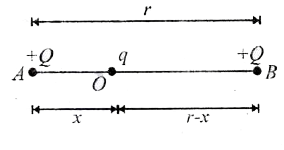
Let a charge q be placed at point such that its distance from charge at A = x and from charge at B = r - x. Now, the system will be in equilibrium if electrostatic force on q due to charge at A = electrostatic force on q due to charge at B.
That is, `(1)/(4pivarepsilon_(0)(qQ)/x^(2))=1/4(4pivarepsilon_(0)).(qQ)/((r-x)^(2)`
`:." "x^(2)=(r-x)^(2) implies x=(r-x)`
or`" "2x=r" "implies" "x" "=r/2`
This means that q must be placed at the centre of teo chargrs `+Q` each.
Now, the three change will be in equilibrium if the net force on each charge is zero.
i.e., `1/(4pivarepsilon_(0))(qQ)/((r//2)^(2))+1/(4pivarepsilon_(0)).("QQ")/r^(2)=0 implies" "q=-Q/4.`
Promotional Banner

Similar Questions

Explore conceptually related problems

A charge q is placed at the centre of line joining two equal charges Q. Show that the system of three charges will be in equilibrium if q = -Q/4

A charge q is placed at the centre of the line joining two exactly equal positive charges Q. the system of three charges will be in equilibrium, if q is equal to:

Two identical point charges of charge Q are kept at a distance r from each other. A third point charge is placed on the line joining the above two charges, such that all the three charges are in equilibrium. Calculate the magnitude and location of the thrid charge.

A charge q is placed at the centre of a cube of side l . What is the electric flux passing through two opposite faces of the cube?

A point charge q is placed at the origin. How does the electric field due to the charge vary with distance r from the origin?

Three charges -q, Q and -q are placed at equal distances on a striaght line. If the potential energy of the system of three charges is zero, then what is the ratio of Q:q?

Three charges each of value q are placed the corers of an equilaterla triangle. A fourth charge Q is placed at the centre of the triangle. If Q = -q, will the charges at the corners move towards the centre or fly away from it?

Three charges each of value q are placed the corners of an equilaterla triangle. A fourth charge Q is placed at the centre of the triangle. For what value of Q, will the charges remain stationary? In this situation, how much work is done in removing the charges to infinity?

A thin metallic spherical shell of radius R carries a charge Q on its surface. A point charge Q/2 is placed at its centre C and another charge +2Q outside the shell at a distance r from the centre as shown in figure. Find the force on the charge at the centre of shell and at point A.

A spherical conducting shell of inner radius r_1 and outer radius r_2 has a charge Q. A charge q is placed at the centre of the shell. What is the surface charge density on the inner and outer surfaces of the shell?
