

Home
Class 12
CHEMISTRY
Here each question contains statements g...

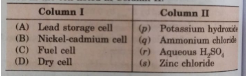
Here each question contains statements given in two columns which have to the matched statements in column I are labelled as A,B, C and D where as statement in column II are labelled as p,q,r and s. the answer to these questions are to be bubbled 4 x 4 matrix. if the correct matched are A-p,A-s,B-q,C-p, and D-p then the correctly bubbled matrix should look like the following
Match the type of cell in column I with the elelctroyte used in the cell listed in column II.

Promotional Banner

Topper's Solved these Questions

  • ELECTROCHEMISTRY

    MODERN PUBLICATION|Exercise EXERCISE|529 Videos
  • d-AND f- BLOCK ELEMENTS

    MODERN PUBLICATION|Exercise EXERCISE|1089 Videos
  • GENERAL PRINCIPLES AND PROCESSES OF ISOLATION OF ELEMENTS

    MODERN PUBLICATION|Exercise EXERCISE|303 Videos

Similar Questions

Explore conceptually related problems

Here each question contains statements given in two columns which have to the matched statements in column I are labelled as A,B, C and D where as statement in column II are labelled as p,q,r and s. the answer to these questions are to be bubbled 4 x 4 matrix. if the correct matched are A-p,A-s,B-q,C-p, and D-p then the correctly bubbled matrix should look like the following Match the units in column I with the quantity given in column II

Here each question contains statements given in two columns which have to the matched statements in column I are labelled as A,B, C and D where as statement in column II are labelled as p,q,r and s. the answer to these questions are to be bubbled 4 x 4 matrix. if the correct matched are A-p,A-s,B-q,C-p, and D-p then the correctly bubbled matrix should look like the following Match the electrochemical behavior of metals in column I with the examples listed in column II

Match the type of packing given in column I with the items given in column II.

Match the statement in column I with those given in column II.

Match column I with column II.

Match the following column I with Column II

MODERN PUBLICATION-ELECTROCHEMISTRY-EXERCISE
  1. The questions given below consist of an Assertion and a Reason. Use th...

    Text Solution

    |

  2. Here each question contains statements given in two columns which have...

    Text Solution

    |

  3. Here each question contains statements given in two columns which have...

    Text Solution

    |

  4. Here each question contains statements given in two columns which have...

    Text Solution

    |

  5. The number of metals which can liberated H2 from dil HCl is: Zn,Cu,K,A...

    Text Solution

    |

  6. The e.m.f of the cell Mg(s)|Mg^(2+)(0.1M)||Cu^(2+)(1xx10^-xM)|Cu is 2....

    Text Solution

    |

  7. In the cell reaction: 2Al(s)+3NI^(2+)(aq)rarr2Al^(3+)(aq)+3Ni(s) The v...

    Text Solution

    |

  8. The number of Faradays of electricity required is deposte 81 g of Al f...

    Text Solution

    |

  9. In an electrolysis of acidulated water, 4.48 L of hydrogen was produce...

    Text Solution

    |

  10. Two litres of 0.5 M KMnO4 solution have to be completely reduced in ac...

    Text Solution

    |

  11. The e.m.f of the cell Cu|Cu^(2+)(aq)||Ag^(+)(aq)|Ag is 0.46V. The e.m....

    Text Solution

    |

  12. A cell consists of two hydrogen electrodes. The negative electrode is ...

    Text Solution

    |

  13. The molar conductivity of a solution of a weak acid HX(0.01M) is 10 ti...

    Text Solution

    |

  14. Which cell will measure standard electrode potential of copper electro...

    Text Solution

    |

  15. Electrode potential for Mg electrode varies according to the equation:...

    Text Solution

    |

  16. Which of the following statement is correct?

    Text Solution

    |

  17. The differences between the electrode potentials of two electrodes whe...

    Text Solution

    |

  18. Which of the following statement is not correct about inert electrode ...

    Text Solution

    |

  19. In an electrochemical cell,

    Text Solution

    |

  20. Which is not correct

    Text Solution

    |