

Home
Class 12
CHEMISTRY
The concentrations of a reactant R at di...

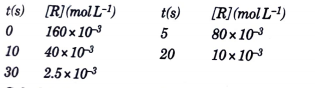
The concentrations of a reactant R at different times are given below:

Calculate the average rate of reaction, `R rarr P` during different intervals of time.

Promotional Banner

Topper's Solved these Questions

  • CHEMICAL KINETICS

    MODERN PUBLICATION|Exercise EXERCISE|531 Videos
  • BIOMOLECULES

    MODERN PUBLICATION|Exercise EXERCISE|503 Videos
  • CHEMISTRY IN EVERYDAY LIFE

    MODERN PUBLICATION|Exercise EXERCISE|352 Videos

Similar Questions

Explore conceptually related problems

For the reaction R rarr P, write the differential rate law.

For the reaction R rarr P , the concentration of a reactant changes from 0.03M to 0.02M in 25 minutes. Calculate the average rate of reaction using units of time both in minutes and seconds.

Hydrolysis of methyl acetate in aqueous solution has been studied by titrating the liberated acetic acid against sodium hydroxide. The concentration of the ester at different times is given below. Show that it follows a pseudo first order reaction, as the concentration of water remains nearly constant (55 mol L^(-1)), during the course of the reaction. What is the value of k in this equation? Rate = k [CH_3C00CH_3][H_20]

Calculate the value of universal gas constant R in two different units.

If a is the initial concentration of the reactant what is the time required for 100 % completion of a zero order reaction

In a pseudo first order hydrolysis of ester in water the following results were obtained: Calculate the average rate of reaction between the time interval 30 to 60 seconds.

The pressure of a gas decomoposing at the surface of a solid catalyst has been measured at different times and the results are given below : Determine the order of reaction, its rate constant and half life period.

If the initial concentration of the reactant is doubled, the time for half reaction is also doubled. Then order of the reaction is

When the concentration of a reactant of a second order is tripled, then rate will become ............. times.

Write two three difference between average rate of reaction and instantaneous rate of reaction

MODERN PUBLICATION-CHEMICAL KINETICS-EXERCISE
  1. The concentrations of a reactant R at different times are given below:...

    Text Solution

    |

  2. How can we express the rates of following reactions in terms of concen...

    Text Solution

    |

  3. How can we express the rates of following reactions in terms of concen...

    Text Solution

    |

  4. How can we express the rates of following reactions in terms of concen...

    Text Solution

    |

  5. For the reaction, N2+3H2 rarr 2NH3 the rate of reaction measured as (D...

    Text Solution

    |

  6. For the reaction : 2N2O5 rarr 4NO2+O2 the rate of reaction measured as...

    Text Solution

    |

  7. A reaction, 3X rarr 2Y+Z proceeds in a closed vessel. The rate of disa...

    Text Solution

    |

  8. Consider the reaction: 4NO2(g) + O2(g) rarr 2N2O5(g) In an experim...

    Text Solution

    |

  9. Explain with examples the meaning of the terms average rate and instan...

    Text Solution

    |

  10. A reaction 3X rarr 2Y+Z procees in a closed vessel. The rate of disapp...

    Text Solution

    |

  11. The rate of formation of a Second order dimerisation reaction is 5.8xx...

    Text Solution

    |

  12. The gas phase decomposition of COCl2, COCl2 (g) rarr CO(g) + Cl2 (g) f...

    Text Solution

    |

  13. Identify the reaction order for each of the following rate constants -...

    Text Solution

    |

  14. Identify the reaction order for each of the following rate constants -...

    Text Solution

    |

  15. Identify the reaction order for each of the following rate constants -...

    Text Solution

    |

  16. Identify the reaction order for each of the following rate constants -...

    Text Solution

    |

  17. Identify the reaction order for each of the following rate constants -...

    Text Solution

    |

  18. For a reaction: A+B rarr Products, the rate is given as k[A]^(1//3) ...

    Text Solution

    |

  19. The rate law for a reaction is found to be : Rate = k [NO2^(-) [I^(-)]...

    Text Solution

    |

  20. The rate law for a reaction is found to be : Rate = k [NO2^(-) [I^(-)...

    Text Solution

    |

  21. The rate law for a reaction is found to be : Rate = k [NO2^(-) [I^(-)...

    Text Solution

    |