

Home
Class 12
CHEMISTRY
The following results were obtained for ...

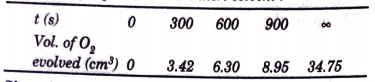
The following results were obtained for the decomposition of nitrogen peroxide in an inert solvent :

Show that the reaction is of first order and also calculate the rate constant.

Promotional Banner

Topper's Solved these Questions

  • CHEMICAL KINETICS

    MODERN PUBLICATION|Exercise EXERCISE|531 Videos
  • BIOMOLECULES

    MODERN PUBLICATION|Exercise EXERCISE|503 Videos
  • CHEMISTRY IN EVERYDAY LIFE

    MODERN PUBLICATION|Exercise EXERCISE|352 Videos

Similar Questions

Explore conceptually related problems

How is half life period of a first order reaction related to its rate constant ?

The following data were obtained during the first order thermal decomposition of SO_2Cl_2 at a constant volume : SO_2Cl_2 (g) rarr SO_2(g)+ Cl_2(g) Calculate the rate constant. (Given : log 4 = 0.6021, log 2 = 0.3010)

Thermal decomposition of dinitrogen penta oxide takes place by the following mechanism: Write the rate expression and order of reaction. What is the unit of rate constant ?

For the decomposition of azoisopropane to hexane and nitrogen at 543 K, the following data is obtained. Calculate the rate constant.

The following data were obtained during the first order decomposition of 2A(g) rarr B(g) + C(s) at a constant volume and at a particular temperature. The rate constant in mi n^-1 is

Time required to decompose SO_2 Cl_2 to half of its initial amount Is 60 minutes. If the decomposition is a first order reaction, calculate the rate constant of the reaction.

If the half life period of a first order reaction is 100 seconds, then rate constant will be

The following data were obtained for the reaction: 2NO(g)+Br_2(g) rarr 2NOBr(g) Determine rate constant.

The following rate data were obtained at 303 K for the following reaction : 2A +B rarr C+D The order of the reaction is :

The half-life period for a first order reaction is 69.3 s. Its rate constant is:

MODERN PUBLICATION-CHEMICAL KINETICS-EXERCISE
  1. The following results were obtained for the decomposition of nitrogen ...

    Text Solution

    |

  2. How can we express the rates of following reactions in terms of concen...

    Text Solution

    |

  3. How can we express the rates of following reactions in terms of concen...

    Text Solution

    |

  4. How can we express the rates of following reactions in terms of concen...

    Text Solution

    |

  5. For the reaction, N2+3H2 rarr 2NH3 the rate of reaction measured as (D...

    Text Solution

    |

  6. For the reaction : 2N2O5 rarr 4NO2+O2 the rate of reaction measured as...

    Text Solution

    |

  7. A reaction, 3X rarr 2Y+Z proceeds in a closed vessel. The rate of disa...

    Text Solution

    |

  8. Consider the reaction: 4NO2(g) + O2(g) rarr 2N2O5(g) In an experim...

    Text Solution

    |

  9. Explain with examples the meaning of the terms average rate and instan...

    Text Solution

    |

  10. A reaction 3X rarr 2Y+Z procees in a closed vessel. The rate of disapp...

    Text Solution

    |

  11. The rate of formation of a Second order dimerisation reaction is 5.8xx...

    Text Solution

    |

  12. The gas phase decomposition of COCl2, COCl2 (g) rarr CO(g) + Cl2 (g) f...

    Text Solution

    |

  13. Identify the reaction order for each of the following rate constants -...

    Text Solution

    |

  14. Identify the reaction order for each of the following rate constants -...

    Text Solution

    |

  15. Identify the reaction order for each of the following rate constants -...

    Text Solution

    |

  16. Identify the reaction order for each of the following rate constants -...

    Text Solution

    |

  17. Identify the reaction order for each of the following rate constants -...

    Text Solution

    |

  18. For a reaction: A+B rarr Products, the rate is given as k[A]^(1//3) ...

    Text Solution

    |

  19. The rate law for a reaction is found to be : Rate = k [NO2^(-) [I^(-)]...

    Text Solution

    |

  20. The rate law for a reaction is found to be : Rate = k [NO2^(-) [I^(-)...

    Text Solution

    |

  21. The rate law for a reaction is found to be : Rate = k [NO2^(-) [I^(-)...

    Text Solution

    |