

Home
Class 12
CHEMISTRY
For the reaction : 2NO(g) + Cl2(g) rarr ...

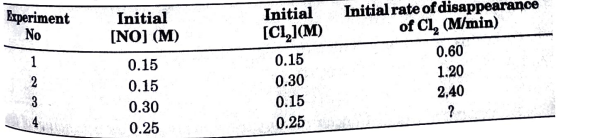
For the reaction : `2NO(g) + Cl_2(g) rarr 2NOCl(g)` the following data were collected. All the measurements were taken at 263 K.

Calculate the value of rate constant and specify its units .

Promotional Banner

Topper's Solved these Questions

  • CHEMICAL KINETICS

    MODERN PUBLICATION|Exercise EXERCISE|531 Videos
  • BIOMOLECULES

    MODERN PUBLICATION|Exercise EXERCISE|503 Videos
  • CHEMISTRY IN EVERYDAY LIFE

    MODERN PUBLICATION|Exercise EXERCISE|352 Videos

Similar Questions

Explore conceptually related problems

For the reaction : 2NO(g) + Cl_2(g) rarr 2NOCl(g) the following data were collected. All the measurements were taken at 263 K. Write the expression for rate law.

For the reaction : 2NO(g) + Cl_2(g) rarr 2NOCl(g) the following data were collected. All the measurements were taken at 263 K. What is initial rate of disappearance of Cl_2 in exp.4 ?

For the reaction : PCl_(5) (g) rarrPCl_(3) (g) +Cl_(2)(g) :

Equilibrium constant for the reaction 2NO(g) + Cl_(2)(g) hArr 2NOCl(g) is correctly given by the expression

Consider the following reaction for 2NO_2(g) + F_2(g) rarr 2NO_2F(g) . The expression for the rate of reaction in terms of the rate of change of Partial pressures of reactant and product is/are

For the non-stoichiometric reaction: 2A+B rarr C+D , the following kinetic data were obtained in three separate experiments, all at 298 K. The rate law for the formation of C is

For the reaction : Cl_2 (g) + 2NO (g) rarr 2 NOCl(g) The rate law is expressed as rate = k[NO]^2 [Cl_2] What is the overall order of the reaction ?

Nitrogen pentoxide decomposes according to equation : 2N_2O_5(g) rarr 4NO_2(g) + O_2(g) This first order reaction was allowed to proceed at 40^@ C and the data below were collected : Calculate the rate constant. Include units with your answer.

For the reaction CO(g)+Cl_(2)(g)hArrCOCl_(2)(g) the value of (K_(c)/(K_(P))) is equal to :

MODERN PUBLICATION-CHEMICAL KINETICS-EXERCISE
  1. The following rate data were obtained for the reaction : 2NO(g) + O2(g...

    Text Solution

    |

  2. For the reaction : 2NO(g) + Cl2(g) rarr 2NOCl(g) the following data we...

    Text Solution

    |

  3. For the reaction : 2NO(g) + Cl2(g) rarr 2NOCl(g) the following data we...

    Text Solution

    |

  4. For the reaction : 2NO(g) + Cl2(g) rarr 2NOCl(g) the following data we...

    Text Solution

    |

  5. Fill in the blanks in the following table which treats a reaction of a...

    Text Solution

    |

  6. In a reaction between A and B, the initial rate of reaction was measur...

    Text Solution

    |

  7. In a hydrolysis reaction, 5g ethyl acetate is hydr olyzed in presence ...

    Text Solution

    |

  8. A first order reaction is 20% complete in 10 minutes. Calculate the ti...

    Text Solution

    |

  9. A first order reaction takes 40 min for 30% completion. Calculate t(1/...

    Text Solution

    |

  10. 50 % of first order reaction gets completed in 16 minutes. What fracti...

    Text Solution

    |

  11. The three fourth of a first order reaction is completed in 32 minutes....

    Text Solution

    |

  12. The half life period for a reaction of first order is 2.31xx10^3 min. ...

    Text Solution

    |

  13. A reaction is first order with vosbect to reactant P having rate const...

    Text Solution

    |

  14. For a first order reaction, half life period (t(1//2)) is 100 seconds....

    Text Solution

    |

  15. The rate constant for a first order reaction is 80 s^-1. How much time...

    Text Solution

    |

  16. The pressure of a gas decomoposing at the surface of a solid catalyst ...

    Text Solution

    |

  17. The half life period of a substance is 60 min at a certain initial con...

    Text Solution

    |

  18. The thermal decomposition of a compound is first order. If 50 % of the...

    Text Solution

    |

  19. A first order reaction takes 69.3 minutes for 50% completion. Calculat...

    Text Solution

    |

  20. The rate of a reaction increases four times when the temperature chang...

    Text Solution

    |