Home
Class 12
CHEMISTRY
In a pseudo first order hydrolysis of es...

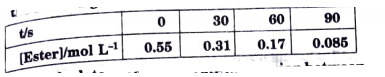
In a pseudo first order hydrolysis of ester in water the following results were obtained:
Calculate the average rate of reaction between the time interval 30 to 60 seconds.


Promotional Banner

Topper's Solved these Questions

  • CHEMICAL KINETICS

    MODERN PUBLICATION|Exercise EXERCISE|531 Videos
  • BIOMOLECULES

    MODERN PUBLICATION|Exercise EXERCISE|503 Videos
  • CHEMISTRY IN EVERYDAY LIFE

    MODERN PUBLICATION|Exercise EXERCISE|352 Videos

Similar Questions

Explore conceptually related problems

In a pseudo first order hydrolysis of ester in water the following results were obtained: Calculate the pseudo first order rate constant for the hydrolysis of ester.

In a pseudo first order hydrolysis of ester in water the following results were obtained : {:("Time t(s)",0,30,60),("Ester (mol "L^(-1)")",0.55,0.31,0.17):} Calculate the pseudo first order rate constant

For the hydrolysis of methyl acetate in aqueous solution, the following results were obtained: Show that it follows pseudo first order reaction, as the concentration of water remains constant.

The concentrations of a reactant R at different times are given below: Calculate the average rate of reaction, R rarr P during different intervals of time.

The following rate data were obtained at 303 K for the following reaction : 2A +B rarr C+D The order of the reaction is :

For a first order reaction, calculate the ratio between the time taken to complete three-fourth of the reaction and the time taken to complete half of the reaction.

For the reaction R rarr P , the concentration of a reactant changes from 0.03M to 0.02M in 25 minutes. Calculate the average rate of reaction using units of time both in minutes and seconds.

A first order reaction takes 30 minutes for 50 % completion. Calculate the time required for 90 % completion of the reaction.

Compounds ‘A’ and ‘B’ react according to the following chemical equation. A(g) + 2B (g) rarr 2C (g) Concentration of either ‘A’ or ‘B’ were changed keeping the concentrations of one of the reactants constant and rates were measured as a function of initial concentration. Following results were obtained. Choose the correct option for the rate equations for this reaction.

MODERN PUBLICATION-CHEMICAL KINETICS-EXERCISE
  1. In a pseudo first order hydrolysis of ester in water the following res...

    Text Solution

    |

  2. How can we express the rates of following reactions in terms of concen...

    Text Solution

    |

  3. How can we express the rates of following reactions in terms of concen...

    Text Solution

    |

  4. How can we express the rates of following reactions in terms of concen...

    Text Solution

    |

  5. For the reaction, N2+3H2 rarr 2NH3 the rate of reaction measured as (D...

    Text Solution

    |

  6. For the reaction : 2N2O5 rarr 4NO2+O2 the rate of reaction measured as...

    Text Solution

    |

  7. A reaction, 3X rarr 2Y+Z proceeds in a closed vessel. The rate of disa...

    Text Solution

    |

  8. Consider the reaction: 4NO2(g) + O2(g) rarr 2N2O5(g) In an experim...

    Text Solution

    |

  9. Explain with examples the meaning of the terms average rate and instan...

    Text Solution

    |

  10. A reaction 3X rarr 2Y+Z procees in a closed vessel. The rate of disapp...

    Text Solution

    |

  11. The rate of formation of a Second order dimerisation reaction is 5.8xx...

    Text Solution

    |

  12. The gas phase decomposition of COCl2, COCl2 (g) rarr CO(g) + Cl2 (g) f...

    Text Solution

    |

  13. Identify the reaction order for each of the following rate constants -...

    Text Solution

    |

  14. Identify the reaction order for each of the following rate constants -...

    Text Solution

    |

  15. Identify the reaction order for each of the following rate constants -...

    Text Solution

    |

  16. Identify the reaction order for each of the following rate constants -...

    Text Solution

    |

  17. Identify the reaction order for each of the following rate constants -...

    Text Solution

    |

  18. For a reaction: A+B rarr Products, the rate is given as k[A]^(1//3) ...

    Text Solution

    |

  19. The rate law for a reaction is found to be : Rate = k [NO2^(-) [I^(-)]...

    Text Solution

    |

  20. The rate law for a reaction is found to be : Rate = k [NO2^(-) [I^(-)...

    Text Solution

    |

  21. The rate law for a reaction is found to be : Rate = k [NO2^(-) [I^(-)...

    Text Solution

    |