

Home
Class 12
CHEMISTRY
In a reaction between A and B, the initi...

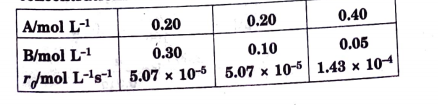
In a reaction between A and B, the initial rate reaction `(r_o)` was measured for different initial concentrations of A and B as given below :

What is the order of the reaction with respect to A and B?

Promotional Banner

Topper's Solved these Questions

  • CHEMICAL KINETICS

    MODERN PUBLICATION|Exercise EXERCISE|531 Videos
  • BIOMOLECULES

    MODERN PUBLICATION|Exercise EXERCISE|503 Videos
  • CHEMISTRY IN EVERYDAY LIFE

    MODERN PUBLICATION|Exercise EXERCISE|352 Videos

Similar Questions

Explore conceptually related problems

In a reaction between A and B, the initial rate of reaction was measured for the ferent initial concentrations of A and B as given below : What is the order of reaction with respect to A and B ?

The initial rates of reaction E 3A + 2B + C rarr Products, at different initial concentrations are given below The order with respect to the reactants, A, B and C are respectively

The t_(1//2) of a reaction is halved as the initial concentration’ the reactant is doubled. What is the order of the reaction?

For a chemical reaction A rarr B , the rate of reaction doubles when the concentration of A is doubled. What is the order of reaction ?

For a reaction : A+ B rarr product, it is observed that (i) on doubling the concentration of A only, the rate of reaction is also doubled. (ii) on doubling the initial concentration of both A and B, there is change by a factor of 8 in the rate of reaction. The rate of reaction is given by

For a chemical reaction R rarr P the variation in the concentration (R) vs. time (t) plot is given as Predict the order of the reaction.

For a chemical reaction R rarr P , the rate of reaction does not change when the concentration of R is changed. What is the order of reaction ?

For a certain chemical reaction, Variation in the concentration, In[R] vs time (min) plot is shown below: For this reaction :What is the order of the reaction ?

MODERN PUBLICATION-CHEMICAL KINETICS-EXERCISE
  1. In a reaction between A and B, the initial rate reaction (ro) was meas...

    Text Solution

    |

  2. How can we express the rates of following reactions in terms of concen...

    Text Solution

    |

  3. How can we express the rates of following reactions in terms of concen...

    Text Solution

    |

  4. How can we express the rates of following reactions in terms of concen...

    Text Solution

    |

  5. For the reaction, N2+3H2 rarr 2NH3 the rate of reaction measured as (D...

    Text Solution

    |

  6. For the reaction : 2N2O5 rarr 4NO2+O2 the rate of reaction measured as...

    Text Solution

    |

  7. A reaction, 3X rarr 2Y+Z proceeds in a closed vessel. The rate of disa...

    Text Solution

    |

  8. Consider the reaction: 4NO2(g) + O2(g) rarr 2N2O5(g) In an experim...

    Text Solution

    |

  9. Explain with examples the meaning of the terms average rate and instan...

    Text Solution

    |

  10. A reaction 3X rarr 2Y+Z procees in a closed vessel. The rate of disapp...

    Text Solution

    |

  11. The rate of formation of a Second order dimerisation reaction is 5.8xx...

    Text Solution

    |

  12. The gas phase decomposition of COCl2, COCl2 (g) rarr CO(g) + Cl2 (g) f...

    Text Solution

    |

  13. Identify the reaction order for each of the following rate constants -...

    Text Solution

    |

  14. Identify the reaction order for each of the following rate constants -...

    Text Solution

    |

  15. Identify the reaction order for each of the following rate constants -...

    Text Solution

    |

  16. Identify the reaction order for each of the following rate constants -...

    Text Solution

    |

  17. Identify the reaction order for each of the following rate constants -...

    Text Solution

    |

  18. For a reaction: A+B rarr Products, the rate is given as k[A]^(1//3) ...

    Text Solution

    |

  19. The rate law for a reaction is found to be : Rate = k [NO2^(-) [I^(-)]...

    Text Solution

    |

  20. The rate law for a reaction is found to be : Rate = k [NO2^(-) [I^(-)...

    Text Solution

    |

  21. The rate law for a reaction is found to be : Rate = k [NO2^(-) [I^(-)...

    Text Solution

    |