Home
Class 12
CHEMISTRY
The following data were obtained during ...

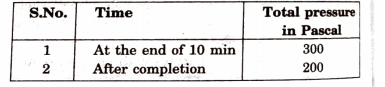
The following data were obtained during the first order decomposition of `2A(g) rarr B(g) + C(s)` at a constant volume and at a particular temperature.

The rate constant in `mi n^-1` is

A

`0.0693 `

B

69.3

C

6.93

D

`6.93xx10^-4`

Text Solution

Verified by Experts

Promotional Banner

Topper's Solved these Questions

  • CHEMICAL KINETICS

    MODERN PUBLICATION|Exercise EXERCISE|531 Videos
  • BIOMOLECULES

    MODERN PUBLICATION|Exercise EXERCISE|503 Videos
  • CHEMISTRY IN EVERYDAY LIFE

    MODERN PUBLICATION|Exercise EXERCISE|352 Videos

Similar Questions

Explore conceptually related problems

The following data were obtained during the first order thermal decomposition of SO_2Cl_2 at a constant volume : SO_2Cl_2 (g) rarr SO_2(g)+ Cl_2(g) Calculate the rate constant. (Given : log 4 = 0.6021, log 2 = 0.3010)

The following data were obtained during the first order thermal decomposition of N_2O_5 (g) at constant volume: 2N_2O_5 (g) rarr 2N_2O_4 (g) +O_2(g)

The following data were obtained during the first order thermal decomposition of SO_2Cl_2 at a constant volume. SO_2Cl_2 (g)rarr SO_2(g) + Cl_2(g) Calculate the rate of the reaction when total pressure is 0.65 atm.

The following data were obtained for the reaction: 2NO(g)+Br_2(g) rarr 2NOBr(g) Determine the rate law?

The following data were obtained for the reaction: 2NO(g)+Br_2(g) rarr 2NOBr(g) Determine rate constant.

The following data were obtained for the reaction: 2NO_2(g)+F_2(g) rarr 2NO_2F Determine: rate law.

The following data were obtained for the reaction: 2NO_2(g)+F_2(g) rarr 2NO_2F Determine: order of reaction.

The following data were obtained for the reaction: 2NO(g)+Br_2(g) rarr 2NOBr(g) Determine: the orders with respect to NO and Br_2

The following results were obtained for the decomposition of nitrogen peroxide in an inert solvent : Show that the reaction is of first order and also calculate the rate constant.

The following rate data were obtained at 303 K for the following reaction : 2A +B rarr C+D The order of the reaction is :

MODERN PUBLICATION-CHEMICAL KINETICS-EXERCISE
  1. If the activation energy for the forward reaction 150 kJ mol^-1 and th...

    Text Solution

    |

  2. Fill in the blanks- is an alloy made up of 90% of copper and 10% of a...

    Text Solution

    |

  3. The following data were obtained during the first order decomposition ...

    Text Solution

    |

  4. The time required for 100% completion of a zero order reaction is

    Text Solution

    |

  5. The rate of reaction A rarr Products, at the initial concentration of ...

    Text Solution

    |

  6. For first order reaction, rate constant

    Text Solution

    |

  7. Fill in the blanks- is an alloy which is used for making coins and co...

    Text Solution

    |

  8. Fill in the blanks- is an alloy made up of 88% of Cu, 10% of Sn and 2...

    Text Solution

    |

  9. The half-life for decay of 14C by beta-emission is 5730 years. The fra...

    Text Solution

    |

  10. For a chemical reaction at 27^@C, the activation energy is 600 R. The ...

    Text Solution

    |

  11. Fill in the blanks- alloy is made up of 5% of aluminium and 95% of ma...

    Text Solution

    |

  12. Temperature coefficient of a reaction is ‘2. When temperature is incr...

    Text Solution

    |

  13. State the number of electrons present in the outermost shell of the at...

    Text Solution

    |

  14. For the following reaction : NO2(g) + CO(g) rarr NO(g) + CO2(g), the ...

    Text Solution

    |

  15. The rate of a reaction is given by rate, r = k [H^+]^n If the rate bec...

    Text Solution

    |

  16. A piece of wood from an archaeological sample has 5.0 counts mi n^-1 p...

    Text Solution

    |

  17. For the reaction A + 2B rarr C, the reaction rate is doubled if the co...

    Text Solution

    |

  18. Fill in the blanks- is an alloy made up of 95% of aluminium, 1% of ma...

    Text Solution

    |

  19. The relationship between rate constant and half life period of zero or...

    Text Solution

    |

  20. For the reaction O(3(g)) + O((g)) rarr 2O(2(g)), if the rate law expre...

    Text Solution

    |

