Home
Class 14
REASONING
In the following question, one statement...

In the following question, one statement is given , followed by two conclusion I and II. You have to consider the statement to be true even if it seems to be at variance from commonly known facts. You have to decide which of the given conclusions, if any, follow from the given statement.
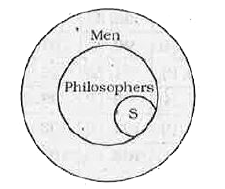
Statement : All philosophers are men. Socrates was a philosopher.
Conclusion :
I. Socrates was a man.
II. Women cannot become philosophers.

A

Only I is valid

B

Only II is valid

C

Both are not valid

D

Both are valid

Text Solution

Verified by Experts

The correct Answer is:
D


All philosphere without exception are men. So no woman can be philosopher.
Promotional Banner

Topper's Solved these Questions

  • SYLLOGISM, STATEMENT AND CONCLUSIONS

    KIRAN PUBLICATION|Exercise TYPE II|193 Videos
  • SERIES

    KIRAN PUBLICATION|Exercise TYPE-VI|90 Videos
  • SYMBOLS & NOTATIONS

    KIRAN PUBLICATION|Exercise TYPE-III|38 Videos

Similar Questions

Explore conceptually related problems

In the following question, two statements are given followed by two conclusions I and II. You have to consider the statements to be true even if they seem to be at variance from commonly known facts. You have to decide which of the given conclusions, if any, follows from the given statements. Statements : A graduate is a man. This thief is a graduate. Conclusions : I. This thief is a man. II. Some men are thieves.

In the following question, two statements are given followed by two conclusions I and II. You have to consider the statements to be true even if they seem to be at variance from commonly known facts. You have to decide which of the given conclusions, if any, follows from the given statements. Statements : All men are prisoners. No prisoners are educated. Conclusions : I. All prisoners are educated. II. No men are educated.

In the following question, two statements are given followed by two conclusions I and II. You have to consider the statements to be true even if they seem to be at variance from commonly known facts. You have to decide which of the given conclusions, if any, follows from the given statements. Statements : Some bags are hot. All hot things are cakes. Conclusions : I. All cakes are bags. II. All bags are cakes.

In each of the following questions, two statements are given followed by two/four conclusions I, II, III and IV. You have to consider the two statements to be true even if they seem to be at variance from commonly known facts. You have to decide which of the given conclusions, if any, follow from the given statements. Statements : (a) some players are men. (b) Some men are singers. Conclusions : I. Some singers are men. II. Some players are singers.

In the question, two statements are given, followed by two conclusions, I and II. You have to consider the statements to be true even if it seems to be at variance from commonly known facts. You have to decide which of the given conclusions, if any, follow(s) from the given statements. Statement I: No ties are bows. Statement 2: All bows are silk. Conclusion I: some ties are silk. conclusion II: Some silk are bows.

In the question, two statements are given, followed by two conclusions I and II. You have to consider the statements to be true even if it seems to be at variance from commonly known facts. You have to decide which of the given conclusion, if any, follow(s) from the given statements. Statement 1: No ties are bows. Statement 2: All bows are silk. Conclusion I: Some ties are silk. Conclusion II: Some silk are bows.

In this question some statements are given. You have to consider the statements to be true even if they seem to be at variance from commonly known facts. You have to decide which of the given conclusion, if any, follows from the given statement. All men are mortal. Ramu is a man.

In each of the following questions one/two statements are given followed by two conclusions I and II. You have to consider the two statements to be true even if they seem to be at variance from commonly known facts. You have to decide which of the given conclusions, if any, follow from the given statements. Statements: Dogs have four legs. Tables have four legs. Conclusions I. Tables are dogs. II. Dogs are tables.

In each of the following questions one/two statements are given followed by two conclusions I and II. You have to consider the two statements to be true even if they seem to be at variance from commonly known facts. You have to decide which of the given conclusions, if any, follow from the given statements. Statements : All animals are birds. Some animals are human beings. Conclusions : I. Some human beings are birds. II. Some birds are human be ings.

KIRAN PUBLICATION-SYLLOGISM, STATEMENT AND CONCLUSIONS-TYPE II
  1. In the following question, one statement is given , followed by two co...

    Text Solution

    |

  2. Following a statement, conclusions I, II and III are given. Which one ...

    Text Solution

    |

  3. Following a statement, conclusions I and II are given. Which one of th...

    Text Solution

    |

  4. A conclusion followed by statements I, II and III is given. Which one ...

    Text Solution

    |

  5. A statement followed by two assumptions I and II is given. Which one o...

    Text Solution

    |

  6. A question is followed by two statements I and II. Which one of the fo...

    Text Solution

    |

  7. In the following question a statement is followed by four inferences. ...

    Text Solution

    |

  8. A statement is given followed by four conclusions (1), (2), (3) and (4...

    Text Solution

    |

  9. A statement is given followed by four conclusions (1), (2), (3) and (4...

    Text Solution

    |

  10. In the following questions four alternative conclusions are given for ...

    Text Solution

    |

  11. In the following questions four alternative conclusions are given for ...

    Text Solution

    |

  12. Statement : Imprisonment for Nelson Mandela, for 27yr made Nelson Mand...

    Text Solution

    |

  13. Two statements are given followed by two conclusions I and II. You hav...

    Text Solution

    |

  14. In each of the following questions a statement is given followed by tw...

    Text Solution

    |

  15. Statement : If he is intelligent, he will pass the examination. As...

    Text Solution

    |

  16. In this question a Statement followed by Conclusions, I and II is give...

    Text Solution

    |

  17. In this question a Statement is given followed by two Assumptions, I a...

    Text Solution

    |

  18. A statement is given followed by two conclusions, I and II. You have t...

    Text Solution

    |

  19. A statement is given followed by two conclusions, I and II. You have t...

    Text Solution

    |

  20. In each of the following question statement is followed by two conclus...

    Text Solution

    |

  21. In each of the following question statement is followed by two conclus...

    Text Solution

    |

