Home
Class 14
REASONING
Statements : All children are playful....

Statements :
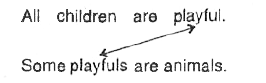
All children are playful.
Some animals are playful.
Conclusions : I. Some animals are chil-dren.
II. Some children are animals.

A

only I follows

B

Neither I nor II follows

C

Only II follows

D

Both I and II follows

Text Solution

Verified by Experts

The correct Answer is:
B

We can align the premises by converting the second premise.

We know that,
`A + I rarr` No conclusion.
Promotional Banner

Topper's Solved these Questions

  • SYLLOGISM, STATEMENT AND CONCLUSIONS

    KIRAN PUBLICATION|Exercise TYPE II|193 Videos
  • SERIES

    KIRAN PUBLICATION|Exercise TYPE-VI|90 Videos
  • SYMBOLS & NOTATIONS

    KIRAN PUBLICATION|Exercise TYPE-III|38 Videos

Similar Questions

Explore conceptually related problems

In each of the following questions one/two statements are given followed by two conclusions I and II. You have to consider the two statements to be true even if they seem to be at variance from commonly known facts. You have to decide which of the given conclusions, if any, follow from the given statements. Statements : All animals are birds. Some animals are human beings. Conclusions : I. Some human beings are birds. II. Some birds are human be ings.

Read the given statements and Conclusions carefully. Assuming that the information given in the statements is true, even if it appears to be at variance with commonly known facts. Decide which of the given Conclusions logically follow(s) from the statements. Statements : 1. Some animals are elephants. 2. Some elephants are tigers. Conclusions : I. Some animals are tigers. II. No tiger is an animal.

Statements:- I. All flowers are leaves. II. Some flowers are plants. Conclusions:- I. Some leaves are plants. II. Some plants are flowers.

Statements:- All lamps are poles. Some poles are pipes. Conclusions:- I. Some lamps are pipes. II. Some poles are pipes.

Statement : Some children are clever. All children are honest. Conclusion: I. Some clever are children. II. Some honest are children. III. Some clever are honest.

Two statements are given, followed by three conclusions numbered I, II and III. Assuming the statements to be true, even if they seem to be at variance with commonly known facts, decide which of the conclusions logically follow(s) from the statements. Statements : Some children are clever All children are honest Conclusions : I. Some clever are children II. Some honest are children III. Some clever are honest

Statements: Now cow is a bull All bulls are animals Some animals are mammals Conclusions: I. At least some animals are bulls II. No animal is a cow.

Statements: Now cow is a bull All bulls are animals Some animals are mammals Conclusions: I. At least some mammals are animals II. Some mammals being bulls is a possibility

KIRAN PUBLICATION-SYLLOGISM, STATEMENT AND CONCLUSIONS-TYPE II
  1. Statements : All children are playful. Some animals are playful. ...

    Text Solution

    |

  2. Following a statement, conclusions I, II and III are given. Which one ...

    Text Solution

    |

  3. Following a statement, conclusions I and II are given. Which one of th...

    Text Solution

    |

  4. A conclusion followed by statements I, II and III is given. Which one ...

    Text Solution

    |

  5. A statement followed by two assumptions I and II is given. Which one o...

    Text Solution

    |

  6. A question is followed by two statements I and II. Which one of the fo...

    Text Solution

    |

  7. In the following question a statement is followed by four inferences. ...

    Text Solution

    |

  8. A statement is given followed by four conclusions (1), (2), (3) and (4...

    Text Solution

    |

  9. A statement is given followed by four conclusions (1), (2), (3) and (4...

    Text Solution

    |

  10. In the following questions four alternative conclusions are given for ...

    Text Solution

    |

  11. In the following questions four alternative conclusions are given for ...

    Text Solution

    |

  12. Statement : Imprisonment for Nelson Mandela, for 27yr made Nelson Mand...

    Text Solution

    |

  13. Two statements are given followed by two conclusions I and II. You hav...

    Text Solution

    |

  14. In each of the following questions a statement is given followed by tw...

    Text Solution

    |

  15. Statement : If he is intelligent, he will pass the examination. As...

    Text Solution

    |

  16. In this question a Statement followed by Conclusions, I and II is give...

    Text Solution

    |

  17. In this question a Statement is given followed by two Assumptions, I a...

    Text Solution

    |

  18. A statement is given followed by two conclusions, I and II. You have t...

    Text Solution

    |

  19. A statement is given followed by two conclusions, I and II. You have t...

    Text Solution

    |

  20. In each of the following question statement is followed by two conclus...

    Text Solution

    |

  21. In each of the following question statement is followed by two conclus...

    Text Solution

    |

